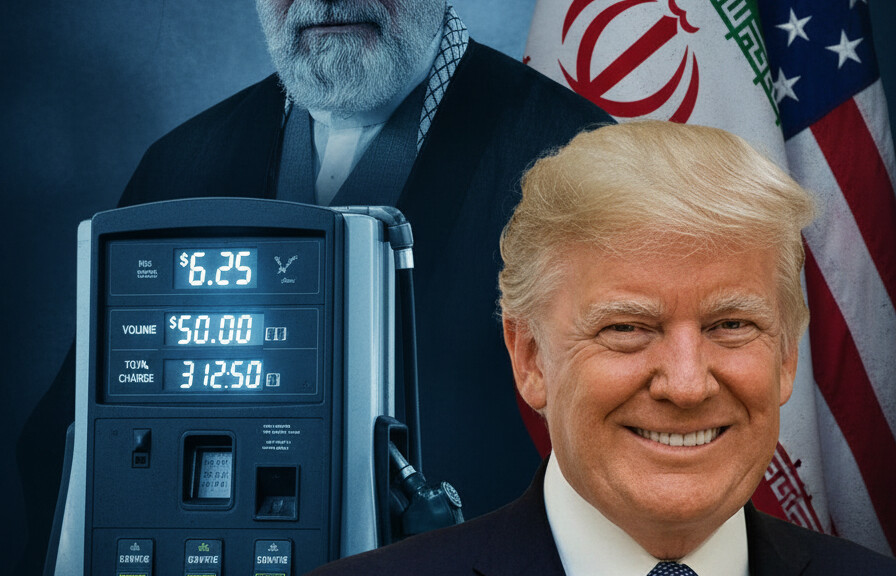
Editorial illustration
President Donald Trump announced Monday that he aims to suspend the federal gas tax “for a period of time” as American families grapple with pump prices exceeding $6 per gallon in many parts of the country. The move comes as the war with Iran extends into its eleventh week, keeping oil prices elevated and straining household budgets across the nation.
In a phone interview with CBS News, Trump acknowledged the economic pressure that rising fuel costs are placing on working Americans. The proposal would require congressional approval, but with Republicans controlling both the House and Senate, the administration appears optimistic about the prospects for passage. The federal gas tax currently stands at 18.4 cents per gallon for gasoline and 24.4 cents per gallon for diesel.
The timing is no coincidence. As Trump and congressional Republicans look toward the 2026 midterm elections, they are acutely aware that voters feel the pain of inflation at the pump every time they fill up their tanks. The Iran conflict has disrupted global oil markets and raised concerns about supply stability, particularly through the strategic Strait of Hormuz where roughly one-fifth of global oil shipments pass.
The administration has been working to manage the economic fallout from the Iran war while maintaining pressure on Tehran to abandon its nuclear ambitions. Trump has repeatedly stated that any agreement with Iran must include the permanent abandonment of nuclear weapons development and the transfer of Iran’s highly enriched uranium stockpile to the United States. “We’re not going to give them the right to have a nuclear weapon,” Trump said Thursday. “Zero chance, and they know that.”
Meanwhile, the administration continues to enforce a naval blockade around Iranian ports while pursuing diplomatic channels. Project Freedom, the U.S.-backed maritime initiative to guide commercial vessels through the Strait of Hormuz, was temporarily paused at the request of Pakistan and other regional partners while negotiations continue. However, Trump has warned that if Iran rejects the emerging framework agreement, the operation could be revived and expanded as “Project Freedom Plus” with additional measures.
The gas tax suspension proposal represents a direct attempt to put money back in Americans’ pockets during a time of international uncertainty. While critics may argue that the move is politically motivated, the reality is that working families are paying the price for global instability every time they drive to work, drop their kids at school, or run errands. The administration’s calculation is straightforward: if Washington can provide immediate relief at the pump, it should.
The proposal also highlights the contrast between Trump’s approach and that of his predecessor. Where the Biden administration seemed content to let prices rise while pursuing green energy policies that made American energy production more expensive, Trump is actively seeking ways to reduce costs for consumers. The federal gas tax suspension would not solve the underlying supply challenges posed by the Iran conflict, but it would provide tangible, immediate relief to millions of households.
Congressional Republicans have expressed support for the measure, though the exact timeline for passage remains unclear. The administration will need to navigate the legislative process while continuing to manage an increasingly complex foreign policy challenge in the Middle East. For now, American drivers can hope that Washington follows through on the president’s proposal and delivers the relief that working families desperately need.
About The Author
