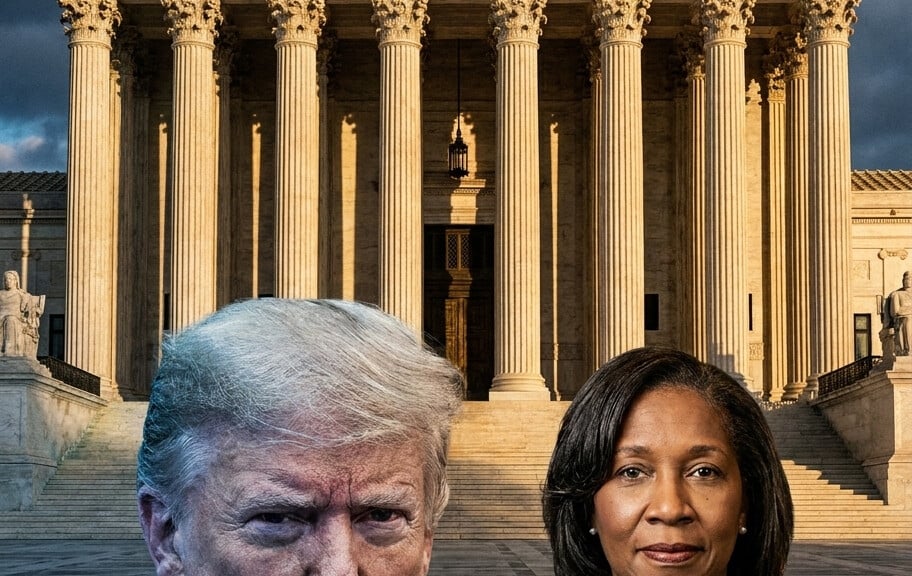
Editorial illustration
The Supreme Court has once again drawn a line in the sand against executive overreach, rejecting President Trump’s attempt to remove Federal Reserve Governor Lisa Cook from her post in a narrow 5-4 decision that preserves the central bank’s independence from political interference. Chief Justice John Roberts, joined by fellow conservative Brett Kavanaugh and the court’s three liberal justices, delivered a ruling that keeps Cook in her position while her legal challenge to Trump’s purported firing proceeds through the courts.
At the heart of this case lies a fundamental question about the limits of presidential power and the sanctity of institutions designed to operate beyond the reach of political winds. The Federal Reserve, created by Congress to manage monetary policy free from short-term political pressures, has enjoyed a unique protected status for over a century. Trump’s attempt to fire Cook—based on allegations of mortgage document issues predating her appointment—represented an unprecedented challenge to that independence. Never before in the Board of Governors’ 111-year history has a president successfully removed a sitting governor.
The facts paint a clear picture of what this was really about. Last summer, as Trump ramped up pressure on Fed Chairman Jerome Powell to cut interest rates, Bill Pulte—then head of the Federal Housing Finance Agency and now Trump’s acting director of national intelligence—suddenly discovered supposed wrongdoing in Cook’s past mortgage applications. The timing was, to put it charitably, convenient. Cook had refused to bend to political pressure on interest rate decisions, insisting on making calls based solely on economic data rather than presidential preferences. Within days of Pulte’s allegations surfacing, Trump demanded her resignation and then purported to fire her when she refused.
Cook’s legal team, led by attorney Abbe Lowell, argued what should be obvious: that “for cause” removal protections apply to conduct during one’s tenure, not decades-old paperwork from before taking office. The lower courts agreed, issuing an injunction that kept Cook on the job. When the Justice Department sought to overturn that injunction, both the district court and appellate court refused. Now the Supreme Court has cemented that protection, at least for now.
Roberts wrote that accepting the government’s position “would in effect transform the Federal Reserve’s for-cause protection into at-will employment—an interpretive leap out of step with the statute Congress enacted and our nation’s tradition of central banking protected from political interference.” He’s right. The Federal Reserve’s independence isn’t some bureaucratic nicety; it’s the foundation that allows monetary policy to serve long-term economic stability rather than short-term political gain.
But the court’s decision wasn’t a complete rebuke of Trump’s expansive view of executive power. In a companion case decided the same day, the same justices ruled that Trump could remove Rebecca Slaughter from the Federal Trade Commission, overturning a 91-year-old precedent that had limited presidential removal powers at independent agencies. The distinction? Roberts drew a line between agencies performing core executive functions and the Federal Reserve’s unique role in monetary policy. Whether that distinction holds up over time—or whether future administrations will test it repeatedly—remains to be seen.
Trump, predictably, didn’t take the loss gracefully. On Truth Social, he posted a characteristically cryptic message suggesting his administration would “take appropriate action immediately to make sure that someone who has committed wrongdoing will not be making vital decisions concerning the Welfare of the United States of America.” What that means is anyone’s guess, given that the Supreme Court has now spoken and Cook remains securely in her position.
For her part, Cook struck a defiant but measured tone. “This was never about mortgage documents signed years before I became a Federal Reserve governor,” she said. “It was an attempt to remove me on a manufactured pretext because I refused to bow to political pressure and continued to set interest rates based only on what would best serve the American people.”
The case isn’t over—Cook’s underlying challenge to her firing still proceeds through the courts. But for now, the principle holds: some institutions are meant to stand apart from the political fray, and the Federal Reserve remains one of them. In an era of increasing executive assertiveness, that’s a victory worth noting.
Source: USA Today, Supreme Court Opinion (25A312)
About The Author
