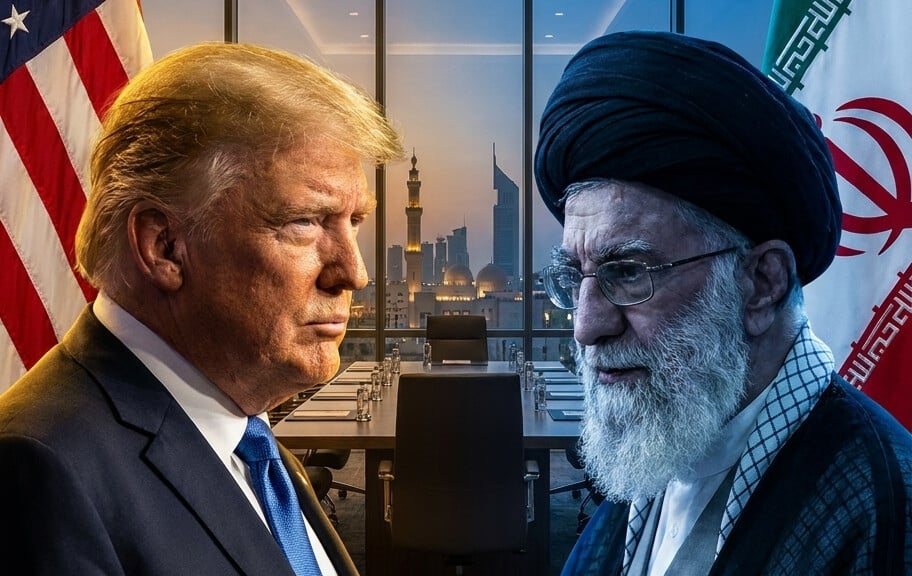
Editorial illustration
President Trump announced Monday that American and Iranian delegations will meet in Doha, Qatar this week for high-level negotiations, even as military skirmishes between the two nations continue to test the fragile ceasefire that ended open warfare earlier this month. The talks represent the most significant diplomatic engagement between Washington and Tehran since the conflict erupted.
“IRAN HAS REQUESTED A MEETING. IT WILL TAKE PLACE TOMORROW IN DOHA!” Trump declared on Truth Social. The American team will be led by Special Envoy Steve Witkoff and Jared Kushner, the president’s son-in-law, according to White House spokeswoman Karoline Leavitt. “Special Envoy Witkoff and Jared Kushner will be flying to Doha for high-level meetings this week as we continue to discuss the memorandum of understanding,” Leavitt told Fox News.
The diplomatic push comes just days after Iran launched missile and drone attacks against American bases in Bahrain and Kuwait, retaliation for US strikes on Iranian positions near the Strait of Hormuz. The waterway, through which roughly one-fifth of global oil shipments pass, has become the primary flashpoint in the ongoing tensions. Iran has asserted control over shipping lanes, firing on vessels passing through routes not designated by Tehran.
Yet Iranian officials struck a more cautious tone than Trump’s announcement suggested. Foreign Ministry spokesman Esmaeil Baghaei stated that while Iran will send a delegation to Doha, it will be to “follow up on the implementation of the MoU,” not to negotiate directly with American counterparts. “We will not have any negotiation meetings at any level with the American side in the coming days,” Baghaei said, adding that the US representatives’ presence “has nothing to do with the visit of the Iranian delegation.”
The 14-point memorandum of understanding reached earlier this month ended active hostilities and initiated a 60-day negotiation period over Tehran’s nuclear program. But implementation has been rocky. Israel has continued operations in Lebanon despite the MoU’s call for a “full ceasefire” ensuring Lebanon’s “territorial integrity and sovereignty.” The US has separately backed an Israeli-Lebanese agreement conditioning Israeli withdrawal on Hezbollah’s disarmament.
Trump, for his part, has emphasized both America’s military dominance and the economic benefits of the deal. “GAS PRICES COMING DOWN, FAST!” he posted Monday, noting that average US gasoline prices have dropped from a May peak of $4.56 to $3.86 per gallon. The decline follows the lifting of Iran’s Hormuz blockade and eased US sanctions on Iranian energy exports.
“We’re winning militarily,” Trump told reporters Monday. “The meeting in Doha is going to be perhaps important, perhaps not. We’re going to find out.” The White House has warned that “violence will be met with violence” if Iran attacks commercial shipping or American interests.
For now, both sides appear to be pursuing parallel tracks, military and diplomatic, each testing the other’s resolve while keeping the door open to a broader settlement. Whether Doha produces breakthrough or breakdown may determine whether the Middle East slides back into open war or takes tentative steps toward lasting stability.
About The Author
