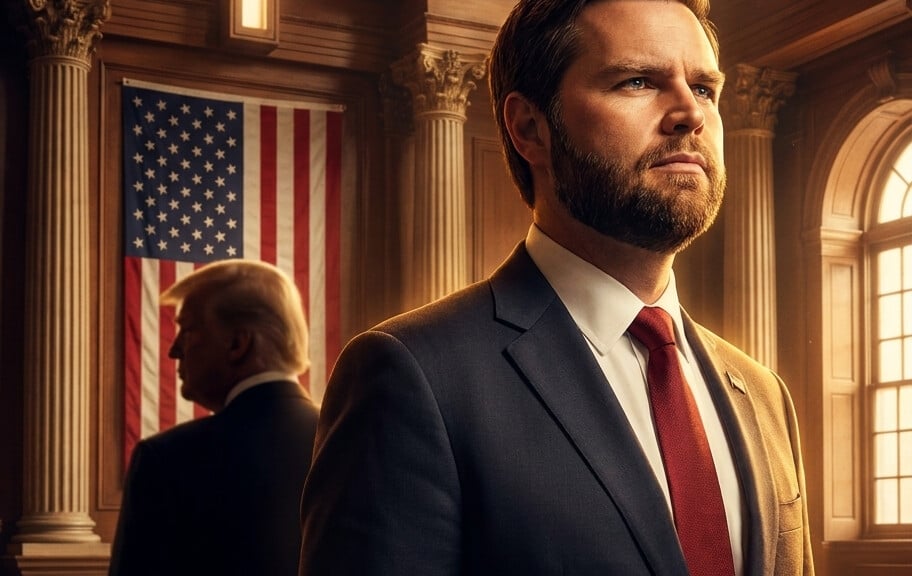
Editorial illustration
Vice President JD Vance is already thinking about the future of the conservative movement, and his vision looks nothing like the Republican Party of the past. In a wide-ranging interview with Daily Wire host Michael Knowles, Vance made clear that the GOP has permanently shifted away from the free-market fundamentalism that defined it for decades.
The economy is not an end in itself, Vance argued, but a tool to serve human dignity and strengthen families. That marks a clean break from the Milton Friedman wing of the party that treated market efficiency as the highest good. Vance explicitly stated that today’s Republican economic policy is now much more Alexander Hamilton than Milton Friedman, embracing tariffs, industrial policy, and manufacturing revival as core conservative priorities.
This is not just policy talk. Vance tied these economic views directly to his Christian faith and his belief that government should support the institutions that give life meaning: family, community, and church. He contrasted this with what he sees as the empty careerism promoted by elite institutions, noting that nobody on their deathbed wishes they had spent less time with their children in exchange for more wealth.
The interview also explored Vance’s intellectual influences, which include St. Augustine, St. Thomas Aquinas, and Catholic social teaching. These are not the thinkers typically cited by Republican vice presidents, but they reflect Vance’s own journey from an unchurched evangelical upbringing through atheism and ultimately to Catholic conversion.
What Vance is describing is a conservatism that prioritizes the common good over abstract principle, that sees government as a tool for building up rather than just getting out of the way. It is a vision that takes the populist energy of the Trump movement and grounds it in deeper philosophical foundations.
Whether this vision succeeds depends on whether the next generation of Republican leaders can articulate it as clearly as Vance has. But one thing is certain: the old consensus is dead, and something new is taking its place.
About The Author
