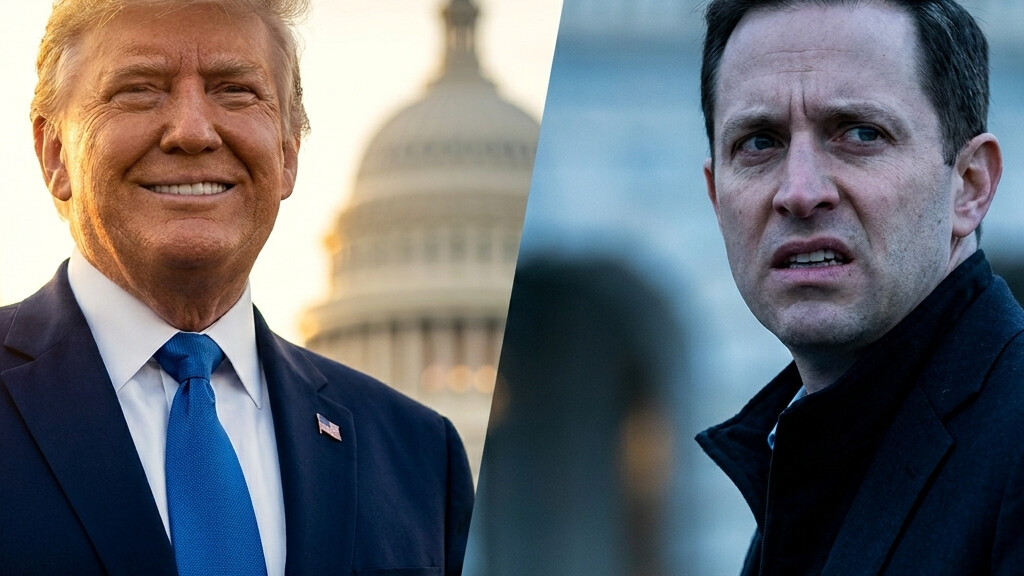
Editorial illustration
President Trump doesn’t hand out endorsements like candy at a parade, so when he throws his weight behind a Republican in a tight race, people pay attention. This week, he made it crystal clear where he stands in the Maine Senate race, and the contrast he drew between the incumbent and her challenger was about as subtle as a sledgehammer.
Susan Collins, the veteran senator from Maine who has served her state for decades, got the presidential seal of approval in the Oval Office on Wednesday. Trump didn’t mince words about why he’s backing her, even while acknowledging they’ve had their differences over the years. “She’s a sane woman,” he told reporters, cutting straight to the point. In an era where common sense sometimes feels like an endangered species in Washington, that simple descriptor carries more weight than any flowery political praise ever could.
The president noted that Collins has never missed a vote in roughly ten thousand roll calls, a streak of reliability that speaks to her work ethic even when they haven’t seen eye to eye. “Unfortunately, because sometimes she voted against me,” Trump quipped, drawing laughter from those gathered. But he was quick to add that she’s a respected person who, while maybe not sharing his exact ideology, operates from a place of reason and dedication to her constituents.
Then the conversation shifted to her opponent, and the temperature in the room changed considerably. Graham Platner, the Democrat who secured his party’s nomination, found himself on the receiving end of some of the harshest language Trump has deployed this campaign season. The president called him a “thug,” a “phony,” and even a “pig” before reconsidering that last insult out of concern for the livestock. “I don’t want to stick him with that one, though, I think pigs would be very upset about it,” Trump added, showing that even in attack mode, he can’t resist a well-timed joke.
What makes this endorsement particularly noteworthy is the history between Trump and Collins. They’ve clashed on key votes before, most notably when she bucked his preferred candidates and positions on various issues. But they also found common ground when it mattered most, like her crucial vote to confirm Justice Brett Kavanaugh to the Supreme Court in 2018. That willingness to put principle over party when necessary, while still generally aligning with conservative governance, is exactly the kind of balanced approach that Trump seems to value in a swing-state senator.
The Maine race is shaping up to be one of the most closely watched contests of the cycle, and Trump’s intervention signals that the Republican Party is taking nothing for granted. With control of the Senate potentially hanging in the balance, every seat matters, and Maine has proven itself to be fertile ground for independent-minded candidates who don’t simply rubber-stamp the party line.
For voters in the Pine Tree State, the choice appears to be between a tested incumbent with a track record of showing up and doing the work, and a challenger who has drawn the ire of a president known for his ability to move votes and shift narratives. Whether Trump’s involvement helps or hurts Collins in a state that has sometimes been skeptical of his brand of politics remains to be seen, but one thing is certain: this race just got a lot more interesting, and a lot more national attention than either campaign probably anticipated just a few weeks ago.
About The Author
