Editorial illustration
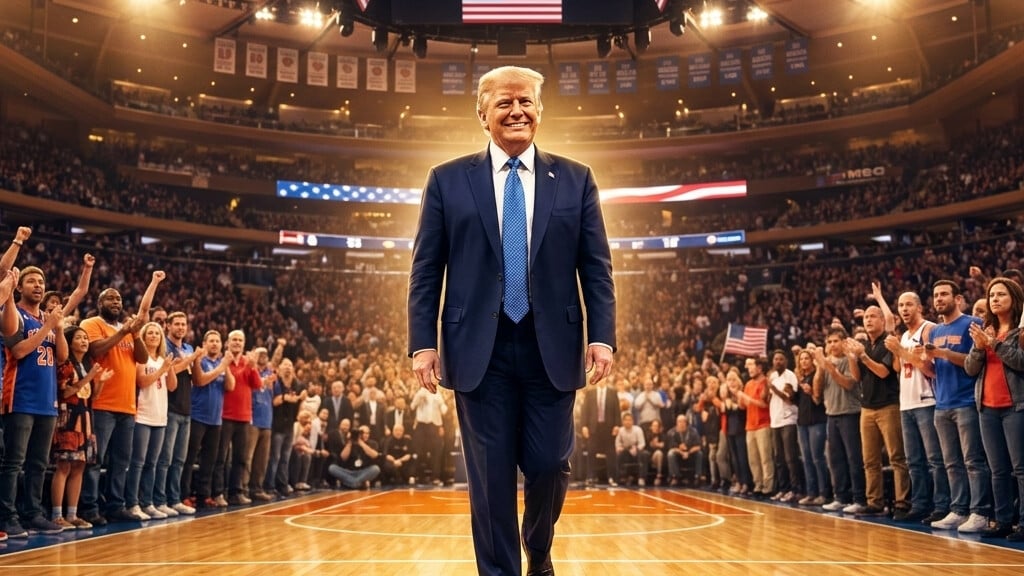
President Trump walked into Madison Square Garden for Game 3 of the NBA Finals and walked straight into the cultural crossfire that has defined his political career. The reception was predictably polarized, a microcosm of America’s divided soul played out on basketball’s biggest stage. As the national anthem played, some in the crowd booed while others cheered, creating that distinctive New York cacophony that greets figures who inspire strong feelings in both directions.
The Knicks have always been more than a basketball team in New York City. They are a civic institution, a shared experience that transcends politics and unites a famously fractious metropolis. When Trump, the Queens native turned Manhattan mogul turned president, enters that space, the collision of worlds becomes inevitable. This is a man who has spent decades shaping the New York skyline and the American political landscape, now returning to his home city as a sitting president to watch a sport he has increasingly embraced as part of his public persona.
NBA Commissioner Adam Silver acknowledged Trump’s genuine fandom, noting that the president truly supports the Knicks rather than merely showing up for political optics. That authenticity matters in a city that can smell performative nonsense from across the Hudson. Trump has attended Knicks games for decades, long before he ever considered a presidential run. His presence at the Garden is not new, but the context has changed dramatically. A private citizen cheering courtside is one thing. A sitting president whose every move carries geopolitical weight is something else entirely.
The security apparatus alone tells the story of how much has changed. Madison Square Garden transformed into a fortress for the evening, with Secret Service agents, metal detectors, and street closures turning a basketball game into a major security event. Players from both the Knicks and Spurs commented on the tightened protocols, a reminder that when the president attends, everyone else’s experience gets filtered through the lens of national security. The Spurs coach contradicted his own star player’s feelings about Trump’s presence, highlighting how even within teams, political reactions vary.
What does it say about America that a president cannot attend a basketball game without becoming the story? That the national anthem itself becomes contested territory, with the crowd’s reaction to the commander-in-chief overshadowing the flag and the republic for which it stands? The booing during the anthem, reported by multiple outlets, represents either courageous free expression or disrespectful partisanship, depending on which cable news channel you watch. Both interpretations miss the deeper truth: America is so divided that even our shared spaces are no longer truly shared.
Trump seemed unfazed, saluting the crowd and smiling through the mixed reception. This is a man who has built his political brand on thriving in exactly this kind of environment, who seems to draw energy from controversy rather than being diminished by it. The New York crowd, for all its noise, likely did not surprise him. He has been booed in this city before. He has been cheered here too. The presidency has not changed the fundamental dynamic of how New Yorkers feel about their most famous native son turned political lightning rod.
As the game played on and the political theater faded into the background, basketball temporarily reclaimed center stage. But the image of Trump at MSG, absorbing both cheers and jeers with that characteristic defiance, will linger as another chapter in the ongoing story of a president who refuses to stay in his lane, who insists on being present in every American space, and who seems to view the entire country as his arena.
About The Author
