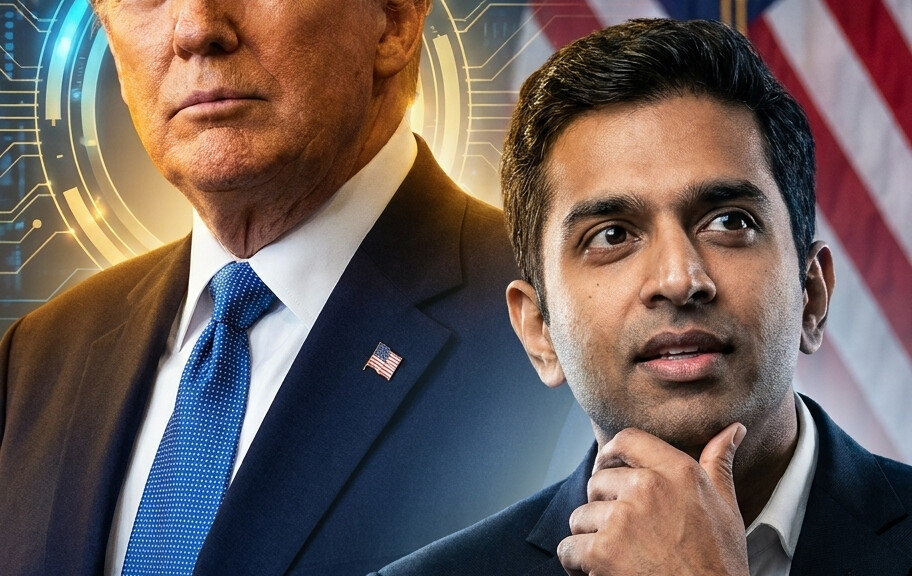
Editorial illustration
Sriram Krishnan, the tech investor who has shaped the Trump administration’s pro-industry artificial intelligence policies, will leave his post as White House senior policy adviser for AI at the end of June. His departure marks a significant transition in how the administration approaches one of the most consequential technologies of our time.
Krishnan has informed administration officials that he plans to start an outside institution focused on influencing technology policy, according to sources familiar with his plans. While planning remains in early stages, the initiative is designed to allow him to continue playing an active role in shaping the administration’s response to AI development.
The departure comes at a pivotal moment. The Trump administration has pursued a notably industry-friendly approach to AI regulation, emphasizing American competitiveness and innovation over the heavy-handed regulatory frameworks favored by some Democrats and European governments. Krishnan, a former tech executive and venture capitalist, has been instrumental in crafting that approach.
His exit raises questions about continuity. Who will fill the policy vacuum? Will the administration maintain its light-touch regulatory stance, or will new voices push for different priorities? The AI landscape is shifting rapidly—China is investing billions, European regulators are tightening restrictions, and American companies are racing to deploy ever-more-powerful systems.
Krishnan’s decision to build an outside institution rather than simply return to private industry suggests he believes the real battle for AI policy will happen in the public sphere, not just government corridors. It’s a recognition that technology policy is increasingly being shaped by a complex ecosystem of think tanks, advocacy groups, and industry coalitions—not just executive orders and agency rules.
For the Trump administration, the challenge now is finding a replacement who can maintain momentum on AI policy while navigating the complex politics of a technology that touches everything from national security to education to employment. The wrong choice could cede ground to regulatory hawks who see AI primarily as a threat to be managed rather than an opportunity to be seized.
Krishnan leaves behind a policy framework that prioritizes American leadership. Whether that framework endures will depend on who picks up the baton.
About The Author
