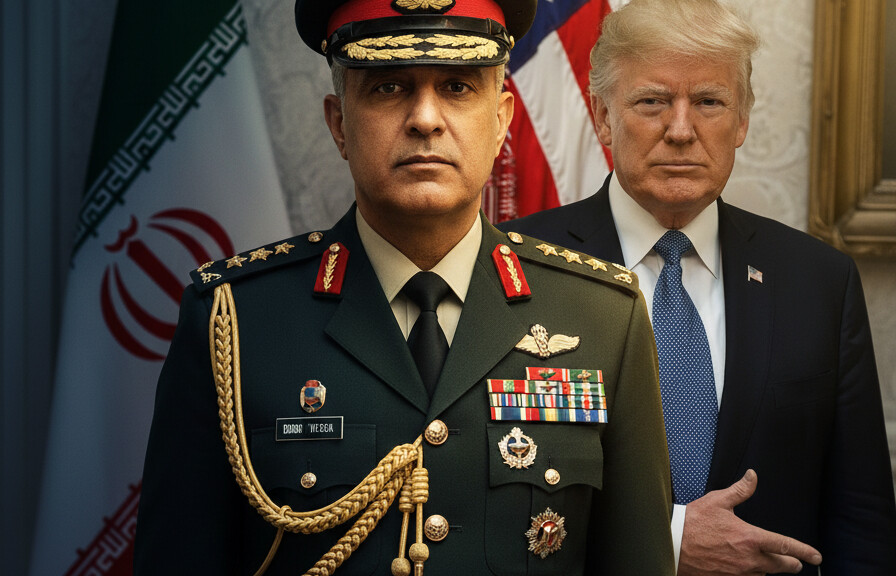
Editorial illustration
While Washington’s foreign policy establishment was busy predicting catastrophe, a uniformed general from Pakistan was quietly doing what decades of American diplomats could not: getting Iran to the negotiating table and keeping them there. President Trump took to Truth Social Friday to publicly thank what he called Pakistan’s “great prime minister and field marshal, two fantastic people!!!” — a remarkable endorsement of Prime Minister Shehbaz Sharif and Army Chief Asim Munir that signals just how central this unlikely duo has become to Middle East peace.
Munir’s rise to Trump’s inner circle is the kind of story that makes the State Department’s careerists uncomfortable. Here is a foreign military chief, steeped in Pakistan’s powerful Inter-Services Intelligence agency, who has managed to earn trust from both the American president and Iran’s security establishment simultaneously. In an era where Washington’s influence in the region has waned, Munir has stepped into the void, becoming the rare figure who can pick up the phone and speak to both sides without preconditions.
The general recently became the first foreign military leader to visit Iran since the latest escalation between Washington and Tehran, arriving in full uniform and receiving a warm greeting from Iranian Foreign Minister Abbas Araghchi. This is no small feat. Iran’s leadership typically views foreign military officials with suspicion bordering on hostility, yet Munir has clearly cultivated relationships that transcend the usual diplomatic formalities.
What makes Munir effective where American negotiators have failed? Part of the answer lies in Pakistan’s unique position. Sharing borders with both Iran and Afghanistan, Islamabad has skin in the game that Washington lacks. A wider war between the U.S. and Iran would destabilize Pakistan’s western frontier, flood the country with refugees, and potentially ignite sectarian tensions that Islamabad has spent years trying to contain. Munir isn’t negotiating for glory or legacy — he’s negotiating because his country’s survival depends on it.
But there’s something else at work here, something that explains Trump’s enthusiasm. Munir appears to understand what American diplomats often forget: deals get made when both sides can claim victory, not when one side is humiliated. The Pakistanis have reportedly been shuttling between capitals, crafting language that allows Tehran to save face while giving Washington the concessions it needs on enrichment and regional behavior.
The contrast with previous American approaches could not be starker. The Obama administration’s JCPOA required Iran to grovel before the international community, accepting inspections and limitations that no sovereign nation would voluntarily endure indefinitely. Not surprisingly, Iran cheated, and Trump tore up the agreement. Now, with Munir’s help, the administration appears to be pursuing a different path — one that respects Iranian dignity while protecting American interests.
Whether this delicate balancing act can produce a durable agreement remains to be seen. Israel remains skeptical, and Iran’s hardliners have every incentive to scuttle talks they view as capitulation. But for the first time in years, there is genuine momentum toward a settlement that doesn’t require American troops to enforce it.
Munir’s emergence as Trump’s “favorite field marshal” says as much about the changing nature of American power as it does about the general’s diplomatic skills. In a multipolar world, the United States can no longer dictate terms to adversaries and expect compliance. We need intermediaries, brokers who understand local dynamics and can navigate cultural complexities that escape even the most seasoned American negotiators. Pakistan’s army chief has proven himself to be exactly that kind of intermediary, and Trump’s praise reflects a pragmatic recognition that sometimes the best diplomacy happens outside traditional channels.
The coming days will test whether Munir’s bridge-building can survive the weight of expectations on all sides. But for now, a Pakistani general has accomplished what seemed impossible just weeks ago: getting America and Iran to talk seriously about peace. However this ends, that is no small achievement.
Source: Fox News
About The Author
