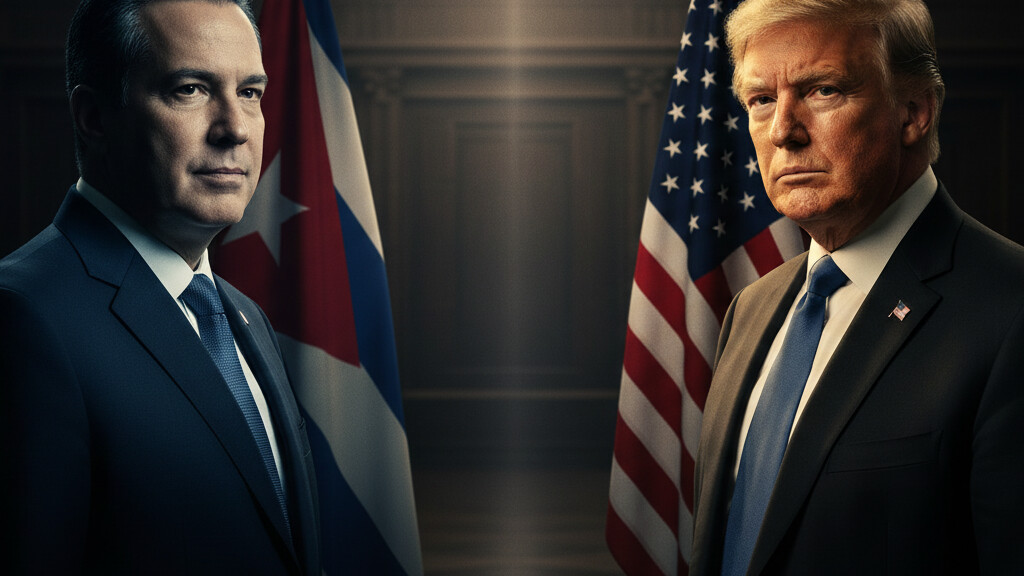
Editorial illustration
While the American media obsesses over palace intrigue and personality politics, a far more consequential story has been unfolding in Havana—one that connects domestic left-wing activism to foreign communist regimes in ways that should concern every citizen who values democratic sovereignty. Recent reporting reveals that leaders of the so-called “Singham Network”—a web of far-left organizations funded by China-based businessman Neville Roy Singham—held high-level meetings with Miguel Díaz-Canel, the strongman head of Communist Cuba, just before organizing a wave of “humanitarian” trips to the island nation.
The delegation included leaders from the People’s Forum, the ANSWER Coalition, the Party for Socialism and Liberation, and other groups that have become fixtures at anti-ICE protests and demonstrations supporting controversial figures like Mahmoud Khalil. These aren’t organic grassroots movements—they’re part of a coordinated network with documented financial ties to Chinese interests and a stated ideological commitment to Marxist revolutionary principles.
What were they doing meeting with the Cuban regime? According to the available reporting, they were discussing “solidarity”—a term that in communist parlance typically means support for the regime’s continued grip on power. This comes at a moment when the Trump administration has been applying significant pressure on the Cuban government, threatening to upend the comfortable arrangement that has allowed the communist dictatorship to survive decades of economic failure and human rights abuses.
The pattern here is becoming impossible to ignore. The same network of activists that organizes protests against American immigration enforcement, that disrupts college campuses in support of foreign nationals who praise terrorist organizations, that produces propaganda content promoted by Chinese state media—that same network is now coordinating directly with one of the last remaining communist dictatorships in the Western Hemisphere. They’re not hiding it anymore. They’re meeting with regime leaders and then organizing public-facing “humanitarian” missions to provide cover for their political activities.
This isn’t about legitimate policy debate over Cuba sanctions or immigration enforcement. This is about foreign-influenced networks operating on American soil to advance the interests of hostile regimes. When activists with documented ties to Chinese funding meet with Cuban communist leadership to strategize about resisting American pressure, that’s not activism—it’s foreign coordination. The House has already subpoenaed Singham over his network’s activities. The question now is whether law enforcement and the American public are paying attention to just how deep these connections run, and what they mean for the integrity of our domestic political discourse.
About The Author
