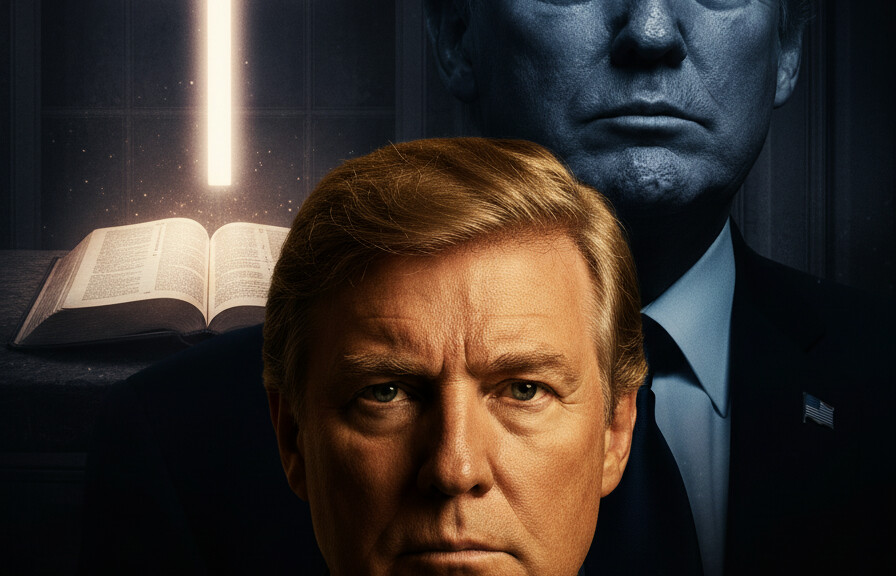
Editorial illustration
Something remarkable happened on Monday night, and it wasn’t just another cable news segment. Tucker Carlson, the man who arguably did more than anyone else to build Donald Trump’s populist coalition, spent forty-three minutes methodically constructing a theological case that the president his audience helped elect might be something far worse than merely flawed. He called him evil. Not misguided, not strategically wrong, but theologically evil. The kind of evil that has a name in Christian tradition, though Carlson never spoke it aloud.
The proximate cause was an Easter Sunday Truth Social post that will live in infamy. At eight in the morning on the holiest day of the Christian calendar, President Trump published a message promising to destroy Iranian power plants and bridges, deploying profanity in a direct threat to the Iranian government, and signing off with a mocking “Praise be to Allah.” On the day Christians celebrate the resurrection of their Savior, the President of the United States chose to issue a profanity-laced threat wrapped in religious mockery.
Carlson framed his response before the monologue even aired: “Desecrating Easter was the first step toward nuclear war. Christians need to understand where Trump is taking us.” This is not the language of political disagreement. This is the language of spiritual alarm.
What followed was extraordinary not for its anger but for its patience. Carlson built his case with the methodical care of a man who understands that his audience knows their Scripture. He began with the Easter post itself, reading it aloud and admitting he did so “honestly in horror.” He let the words sit in the air, unadorned, allowing their weight to settle on viewers who had spent years defending this president against every charge the left could manufacture.
Then came the theological architecture. Carlson’s core claim was deceptively simple: the Bible carries one message across all sixty-six books. You are not God. The limits Scripture places on human behavior exist precisely because power without submission to something higher destroys everything it touches. This is not abstract theology. This is the foundational claim of the entire Christian political tradition that the religious right has claimed to represent for decades.
The evidence Carlson marshaled was specific and devastating. He reminded his audience that Trump refused to place his hand on the Bible at his inauguration, a detail Carlson admitted he witnessed from fifteen feet away and said nothing about at the time. “Maybe he didn’t put his hand on the Bible because he affirmatively rejects what’s inside that book.” That line lands with particular force when you understand where Carlson is going. This is not a charge of hypocrisy. It is a charge of something far more serious.
Then came the moment that transformed the monologue from criticism into something like a sermon. Carlson played footage of Trump’s spiritual advisor Paula White, on video during Holy Week at the White House, comparing Trump to Jesus while Franklin Graham nodded along in the background. For anyone with even passing familiarity with Christian theology, this comparison is not merely awkward flattery. It is disqualifying. The singularity of Christ is not a negotiable doctrine. It is the center of the faith.
Carlson’s response was four words: “That is the end.” Not a gaffe. The end of any good faith claim to Christian political legitimacy. “You cannot allow that in good faith,” he said. “If you’re a Christian, you have to say no to that.” This is the hinge on which the entire monologue turns, the moment where theological argument hardens into moral ultimatum.
He never used the word antichrist. He did something more effective. Deep into the monologue, he invoked Christian dualism with textbook plainness: God creates, Satan destroys. Then he described what Trump wrote on Easter morning. Then he delivered the verdict: “an intentional desecration of beauty and truth, which is the definition of evil.” The conclusion was never stated. It did not need to be. Carlson knows his audience knows their Scripture.
The final verdict was unambiguous. “We can’t support that. Under no circumstances can we support that. That is evil.” Not a messaging problem. Not a tactical error. Evil. Said plainly, to the people who twice carried Trump across the finish line, in the language of the faith they believed they were protecting when they voted for him.
Whether Carlson believes any of it is a legitimate question. He has spent years deploying a kind of tactical nihilism, moving his audience wherever the moment requires. But the context here matters. Carlson went to the White House and argued personally against military escalation in Iran. He lost that argument to Mark Levin, a neocon interventionist with a weekend cable show and Trump’s direct dial. Monday’s monologue is partly a public settling of that private score.
But it is also something more significant. Carlson was handing his audience something they have not had in a decade: a moral exit ramp with theological cover. For a movement that has punished dissent as reflexively as breathing, this was a permission structure to question what many have surely felt but few have dared to say.
The MAGA reaction confirmed Carlson hit something real. Dave Smith called him a modern American hero. The American Conservative amplified his moral case against civilian targeting. The loyalist wing recoiled: Laura Loomer called him “Qatarlson” and demanded ostracism, Nick Fuentes mocked him for defending Islam. The fracture was immediate and public.
What happens now is anyone’s guess. But something has shifted. When the man who helped build the movement turns its own theological language against its leader, the ground beneath begins to move. Carlson has given voice to a question that has surely been forming in the minds of millions of Christians who supported Trump believing they were voting for a flawed vessel who would protect their values. What if they were wrong? What if the vessel was not merely flawed but something else entirely?
The question is now in the open. And it will not go away.
Source: Mediaite
About The Author
