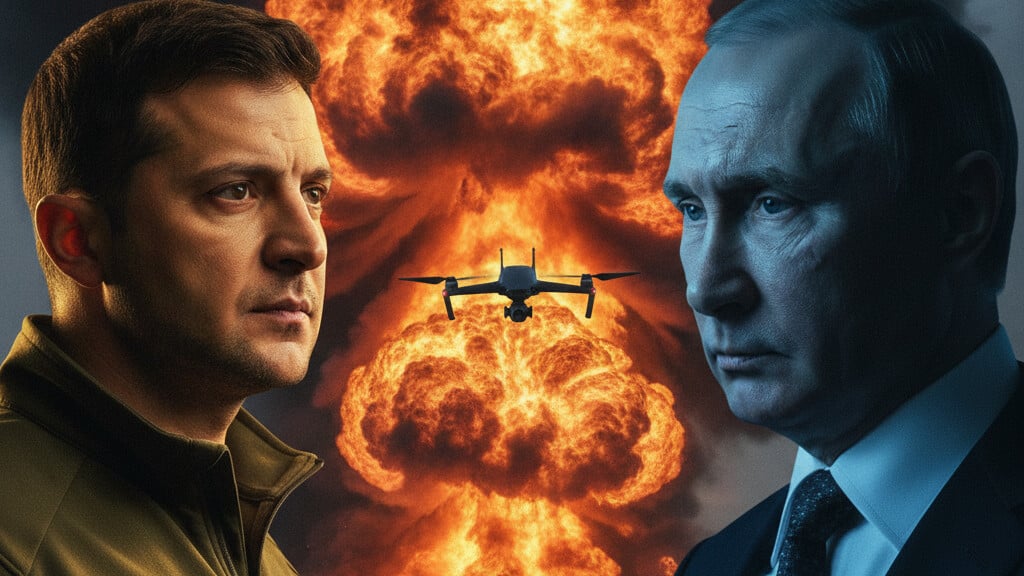
Editorial illustration
Ukrainian drones struck an oil terminal in St. Petersburg on Saturday, Russian officials confirmed, marking one of the most significant long-range attacks on Russian energy infrastructure since the war began and demonstrating Kyiv’s growing capability to hit targets deep inside Russian territory.
The attack targeted the Kirovsky district on the Baltic Sea, with St. Petersburg Governor Alexander Beglov confirming that air defenses shot down 72 Ukrainian drones across Russia’s second-largest city and surrounding region. Despite the defensive measures, the oil terminal sustained damage in what Ukrainian President Volodymyr Zelenskyy described as part of Ukraine’s “long-range sanctions” against Moscow.
“The Ukrainian defense forces hit the port oil infrastructure, which earns money for the Russian war, and there were also hits on Kronstadt – an important military target,” Zelenskyy said in a Telegram post, referring to the strategic island fortress just off the coast of St. Petersburg.
The strike comes as almost daily long-range attacks on Russian oil facilities have created a growing fuel crisis and heaped political pressure on the Kremlin. The conflict, now stretching into its fifth year, has seen Ukraine increasingly shift tactics from defensive operations to offensive strikes aimed at degrading Russia’s economic capacity to sustain the war.
Russian President Vladimir Putin has publicly downplayed the impact of such attacks, describing them as “not critical” and insisting the war will continue until his stated goals are met. He has characterized the strikes on Russian energy infrastructure as an effort by Ukraine to distract from battlefield losses, though military analysts note that Russian advances have slowed considerably in recent months.
The St. Petersburg attack holds particular symbolic significance, striking at the heart of Putin’s hometown and Russia’s imperial capital. The Kirovsky district had been targeted once before in June, ahead of Russia’s flagship St. Petersburg International Economic Forum, suggesting a deliberate strategy of disrupting high-profile Russian events and economic activity.
Meanwhile, the Crimean peninsula, which Russia annexed in 2014, continues to suffer from heavy Ukrainian strikes. Local authorities have been forced to suspend gasoline sales to civilians as attacks intensify. A separate Ukrainian strike on Saturday killed one person and injured two more, including a 10-year-old child, according to Moscow-installed Governor Sergei Aksyonov.
The July 4 timing of the St. Petersburg strike adds another layer of complexity to an already intricate conflict, occurring as Americans celebrate their own independence while Ukraine fights to preserve its sovereignty against Russian aggression. The attack demonstrates that even on a day of American celebration, the grinding reality of Europe’s largest conflict since World War II continues to reshape the geopolitical landscape.
About The Author
