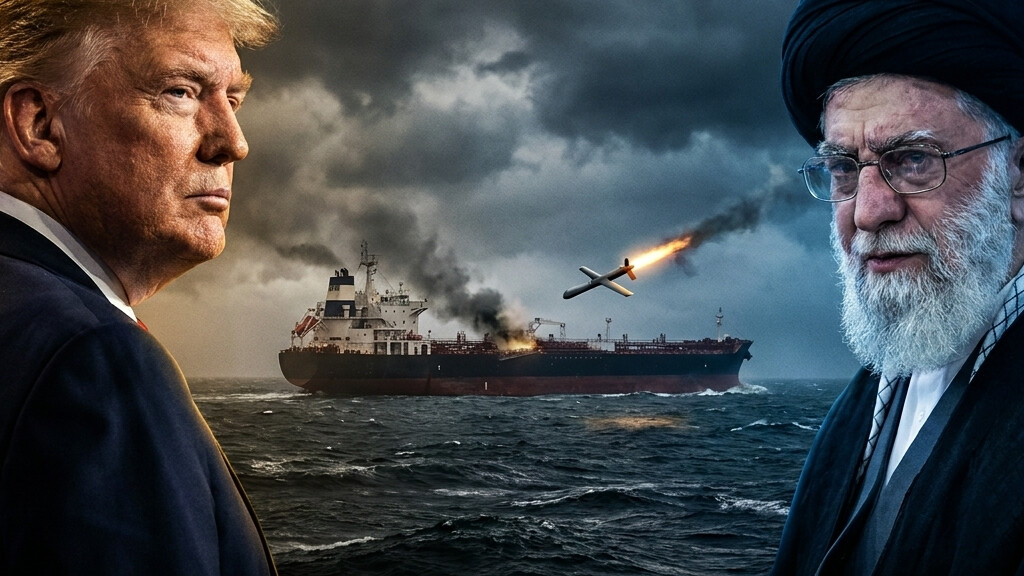
Editorial illustration
President Trump didn’t mince words Friday when he took to Truth Social to blast Iran for what he called a “foolish violation” of the fragile ceasefire agreement that has barely held the Middle East together for weeks. The trigger? Iranian forces launched at least four one-way attack drones at commercial ships traversing the Strait of Hormuz, a move that threatens to reignite a conflict both nations have been desperately trying to walk back from.
The attack marks yet another escalation in a war that has already cost thousands of lives and sent oil prices soaring past $90 per barrel. Iranian drones struck a cargo vessel in the vital waterway, prompting immediate condemnation from the White House and raising serious questions about whether Tehran can be trusted at the negotiating table. Trump made it clear he sees this as a direct breach of faith, not some minor tactical skirmish that can be brushed aside.
What’s particularly galling about this provocation is the timing. Mediators from Pakistan have been shuttling between Washington and Tehran for weeks, hammering out a memorandum of understanding that would extend the ceasefire for 60 days and reopen the Strait of Hormuz to normal commerce. The framework even included potential sanctions relief that could unlock billions in frozen Iranian assets. All of that progress now hangs by a thread because Iranian hardliners couldn’t resist taking another shot at international shipping.
The Revolutionary Guard Corps has been flexing its muscles throughout the conflict, but this latest stunt suggests internal chaos within the Iranian regime. While their own foreign ministry spokesman insists they want peace, the IRGC seems determined to drag both nations back into open warfare. They’ve already threatened to activate Houthi rebels in Yemen to attack the Bab el-Mandeb strait, which would effectively blockade two of the world’s most important energy chokepoints simultaneously.
Israel has been watching these developments with predictable alarm. Prime Minister Netanyahu has already ordered his forces deeper into Lebanon, capturing the medieval Beaufort Castle and threatening strikes on Hezbollah’s “terror headquarters” in southern Beirut. The Israeli leader sees Iran’s aggression for what it is: a sign that the mullahs cannot control their own proxy forces, let alone honor international agreements. With over 3,400 killed in Lebanon since the war began in March, the human cost of Iranian intransigence continues to mount.
Trump’s response has been characteristically blunt. Beyond calling out the “foolish violation,” he’s made it clear the United States will defend its interests and allies. U.S. Central Command has already conducted “self-defense strikes” on Iranian radar and drone sites over the weekend, taking out air defenses and command centers that posed threats to regional shipping. The message is unmistakable: violate the ceasefire at your own peril.
What happens next depends largely on whether Iran’s political leadership can rein in its own military. The regime is hemorrhaging cash due to the ongoing blockade, with oil exports choked off and the economy teetering on collapse. You’d think that would be incentive enough to play by the rules, but the Revolutionary Guard appears more interested in saving face than saving their country from financial ruin. The question is whether Trump will give them another chance or decide that diplomacy has run its course.
About The Author
