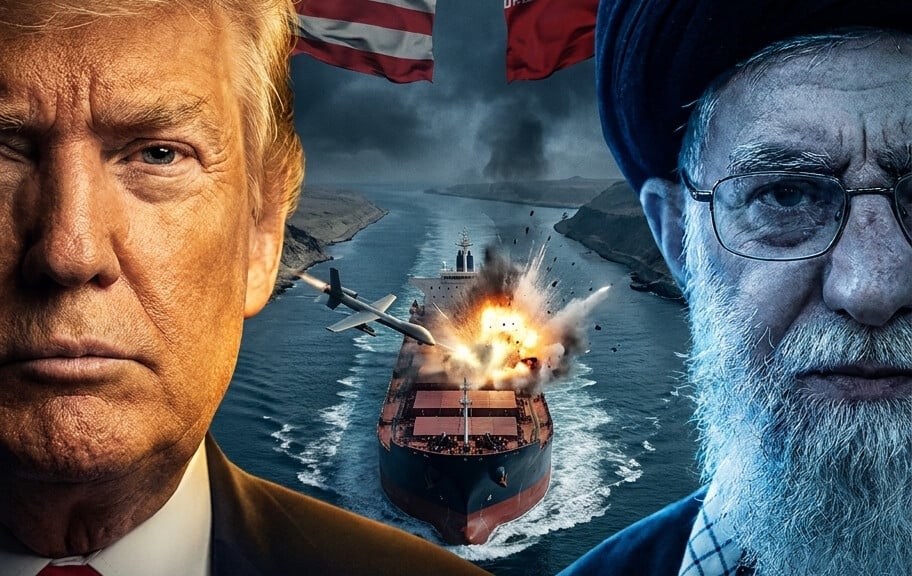
Editorial illustration
President Trump did not mince words Friday when he took to Truth Social to blast Iran for what he called a foolish violation of the fragile ceasefire agreement that had briefly opened the Strait of Hormuz to international shipping. The accusation came after a cargo vessel was struck by what authorities believe was an Iranian drone, marking the most serious breach yet of the truce that ended weeks of direct conflict between the two nations.
The Singapore-flagged vessel Ever Lovely was transiting the critical waterway when it took a hit to its upper deck from an unknown projectile. While the ship sustained damage, it continued on its journey, and thankfully no crew members were injured. But the incident has sent shockwaves through maritime circles and forced the UN International Maritime Organization to hit pause on its evacuation plan for more than 11,000 sailors still stranded in the region.
Trump frustration is palpable and understandable. The administration had brokered a 14-point memorandum of understanding with Tehran that was supposed to end hostilities and reopen one of the world most vital shipping lanes. For a brief moment, it looked like diplomacy had prevailed. Some 115 vessels and 2,500 seafarers made it through the strait before this latest attack threw everything into question.
But here is where it gets complicated. The Iranian Revolutionary Guard Corps had already fired a warning shot, declaring that any ships using routes designated by the IMO without coordinating with Iranian authorities would face consequences. They view the strait as their territorial waters, and they are not afraid to enforce that claim with force. So was this a rogue attack? A calculated test of American resolve? Or simply the chaos of a regime where the left hand does not know what the right hand is doing?
The President claims Iranian forces launched at least four drones at traversing ships, with American defenses intercepting three. That suggests this was not an isolated incident but a coordinated effort to disrupt shipping and test the boundaries of the ceasefire. If that is the case, the question is not whether Iran violated the agreement. It is what Trump intends to do about it.
The administration has already shown willingness to use military force against Iranian targets when provoked. The strikes that preceded this ceasefire were devastating, targeting Iranian nuclear facilities and military installations. Tehran has to know that pushing too hard could reignite a conflict they can ill afford. Yet here we are, watching them poke the bear anyway.
What makes this particularly maddening is the human cost. Those 11,000 sailors waiting to be evacuated are not politicians or military strategists. They are working people from all over the world, trapped in a geopolitical chess match they want no part of. The IMO is trying to negotiate guarantees from both the US and Iran that vessels will not be targeted, but good luck getting the mullahs to put anything in writing.
Trump foolish violation framing is classic Trump. Blunt, direct, and leaving no room for ambiguity. He is treating this as a breach of contract, which in many ways it is. The ceasefire was not just a handshake deal. It was a structured agreement with specific terms. Iran either cannot or will not control its own military forces enough to honor those terms. Either scenario is deeply concerning for anyone hoping this region might achieve some semblance of stability.
The broader implications stretch far beyond the Persian Gulf. Global oil markets are watching this closely. The Strait of Hormuz handles roughly 20 percent of the world petroleum shipments. When Tehran closed it earlier this year, prices spiked and supply chains shuddered. Even the threat of renewed closure is enough to make traders nervous and consumers pay more at the pump.
For now, the President is letting his words do the work, but do not expect that to last if attacks continue. The Trump administration has made clear that American interests and American ships will be protected by whatever means necessary. Iran would do well to remember that before launching any more foolish provocations.
About The Author
