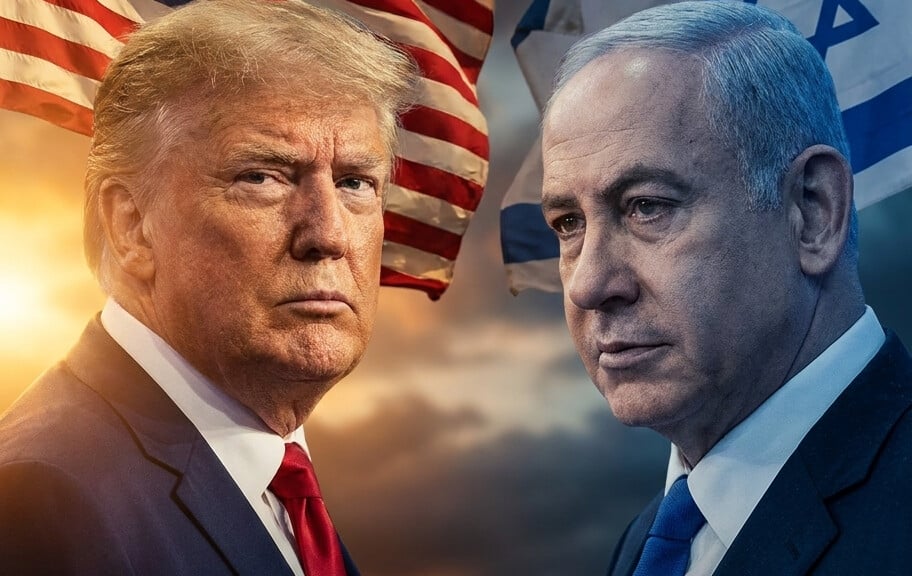
Editorial illustration
President Donald Trump issued a stark warning to Israeli Prime Minister Benjamin Netanyahu Monday, telling the longtime ally that Israel risks being abandoned if it continues military operations against Iran while the United States pushes toward a historic peace agreement. The blunt message came as Trump declared the U.S. is in the final throes of securing a deal that could open the Strait of Hormuz within days and fundamentally reshape Middle Eastern geopolitics.
Speaking to reporters late Monday, Trump did not mince words about his growing frustration with Netanyahu’s government. “I said, ‘Bibi, you better be careful, or you will be on your own very soon,'” the president recounted, according to Axios. The warning follows a weekend flare-up that saw Israel launch deadly bombardments against Beirut, triggering Iranian missile strikes on northern Israel and raising fears that the fragile ceasefire brokered in April could collapse entirely.
The president’s patience appears to be wearing thin after months of navigating between his desire for a landmark diplomatic victory and Israel’s insistence on maintaining military pressure against Iranian proxies in Lebanon. Trump reportedly called Netanyahu on Sunday evening specifically to request restraint, yet Israel proceeded with early Monday strikes targeting Iranian air defense systems and a petrochemical facility. Iran responded in kind, hitting a similar facility in Haifa and targeting two Israeli airbases, though no deaths were reported on either side.
What makes this moment particularly significant is Trump’s assessment of American leverage. The president claimed the U.S. naval blockade on Iran “turned out to be much stronger than bombing” in compelling Tehran toward negotiation. “If we go and bomb, which we can do very easily, if we want, and we spend another two or three weeks bombing, [Iran will] have nothing left whatsoever, but you won’t have the Strait open for months,” Trump explained, outlining the strategic calculation facing his administration.
The Strait of Hormuz, through which roughly one-fifth of global oil shipments pass, has been effectively sealed under a dual U.S.-Iranian blockade that has sent energy markets into turmoil and threatened worldwide economic stability. Trump announced Monday that the critical waterway would open “immediately upon signing” a comprehensive agreement, which he suggested could happen within two or three days. Such a development would represent not merely a diplomatic win but a potential game-changer for global energy markets and American consumers facing elevated prices at the pump.
On Truth Social, Trump demanded both Israel and Iran immediately “stop shooting,” declaring that “final negotiations” toward peace would proceed “subject to ignorance or stupidity getting in its way.” The phrasing was quintessential Trump—part diplomatic urgency, part exasperation with parties he views as potentially sabotaging a deal within reach.
For Netanyahu, the warning presents an acute dilemma. The Israeli leader has built his political career on confronting Iranian regional influence and has consistently prioritized military action against Hezbollah in Lebanon over diplomatic solutions. Yet Trump’s message signals that American patience—and potentially American military support—has limits. Being “on your own” is not merely rhetorical; it carries implications for intelligence sharing, military coordination, and diplomatic cover that Israel has long relied upon in international forums.
The broader context involves Trump’s stated vision for the region. The president has made clear he wants a comprehensive agreement that addresses Iran’s nuclear program, regional proxy activities, and economic reintegration into the global community. Such a deal would represent the kind of historic foreign policy achievement that has eluded American presidents for decades. But it requires all parties—Israel included—to accept compromises that none find entirely satisfactory.
What happens if Netanyahu calls Trump’s bluff? The Israeli leader has survived previous tensions with American administrations, including the famously fraught relationship with the Obama White House. Yet Trump’s warning comes at a moment when Israel faces multiple security challenges and cannot easily afford a rupture with its most important ally. The calculation in Jerusalem over the next 48 hours will determine whether this flare-up becomes a footnote or the beginning of a fundamental realignment in American-Israeli relations.
The world watches as a president who campaigned on ending foreign wars now finds himself threatening to withdraw support from a longtime ally in service of diplomatic breakthrough. Whether this represents strategic genius or dangerous brinkmanship remains to be seen, but one thing is certain: the Middle East has rarely seen a moment quite like this.
About The Author
