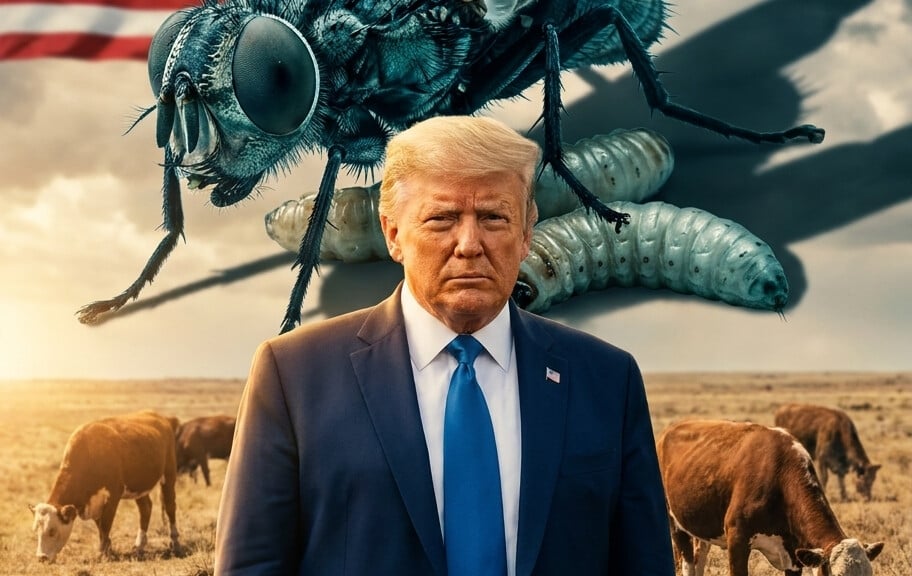
Editorial illustration
The Trump administration is scrambling to contain a growing agricultural crisis as federal officials confirmed multiple new cases of New World screwworm—a flesh-eating parasite previously eradicated from the United States—in Texas livestock. In response, President Trump appointed San Antonio businessman and Texas A&M Regent John Bellinger as USDA’s Senior Advisor for New World Screwworm Preparedness, tasking him with coordinating the federal response to a threat that could devastate the American cattle industry.
The latest confirmations bring Texas’s total to five detected cases in less than a week, with infections now spreading beyond the initial border region. A calf in La Salle County, roughly 90 miles southwest of San Antonio, and a goat in Gillespie County in the Texas Hill Country have both tested positive for the parasite. The geographic spread is particularly troubling because it suggests the pest has established a foothold well beyond the Mexican border zone where it was first detected.
For those unfamiliar with this particular nightmare, New World screwworm is exactly as horrifying as it sounds. Female flies lay eggs in open wounds or body openings of warm-blooded animals. When the eggs hatch, the larvae burrow into living tissue, literally eating their host alive from the inside out. The parasite was eradicated from the United States in the 1960s through an aggressive campaign involving the release of sterile male flies—a technique that remains the primary weapon against the pest today.
The economic stakes could hardly be higher. Texas is the nation’s largest cattle-producing state, and an unchecked screwworm outbreak would send shockwaves through an already strained beef market. Consumers have watched beef prices climb steadily, and the prospect of widespread livestock losses threatens to push costs even higher at the grocery store. For a president who has made lowering food prices a centerpiece of his economic messaging, the timing could not be worse.
What makes this situation particularly complex is the cross-border dimension. The screwworm remains endemic in parts of Mexico and Central America, and the recent detections highlight vulnerabilities in animal movement protocols. A case in Andrews County involving an infested dog that had recently been in Mexico underscores how companion animals—not just livestock—can serve as vectors for the parasite’s spread. Unlike commercial cattle shipments, which face inspection requirements, companion animals largely move across borders without the same scrutiny.
The administration’s response has been swift if somewhat belated. Beyond appointing Bellinger as the new “screwworm czar,” USDA has established a 20-kilometer quarantine and surveillance zone around infected areas and is releasing millions of sterile male flies to combat the pest population. The sterile insect technique works by flooding an area with males that mate with wild females but produce no offspring, gradually collapsing the population over successive generations. It is labor-intensive, expensive, and requires sustained commitment—but it is the only proven method for eliminating New World screwworm once it establishes a presence.
Agriculture Secretary Brooke Rollins has sought to reassure the public that the food supply remains secure, noting that screwworm is “not a virus” and “not a disease” but rather a pest that can be managed with proper veterinary care. Yet the distinction may offer cold comfort to ranchers watching their herds and wondering whether their livelihoods hang in the balance.
The question now is whether the federal response can outpace the parasite’s spread. Screwworm flies can travel significant distances, and each infected animal represents a potential breeding ground for thousands more parasites. The sterile fly releases must achieve sufficient density to overwhelm wild populations—a logistical challenge that grows more difficult with each new detection.
For Trump, the screwworm outbreak represents an unexpected test of administrative competence in a sector where few presidents expect to face crisis. The appointment of a dedicated coordinator signals recognition of the threat’s severity, but the coming weeks will determine whether that response proves adequate. American ranchers—and American consumers—are watching closely.
About The Author
