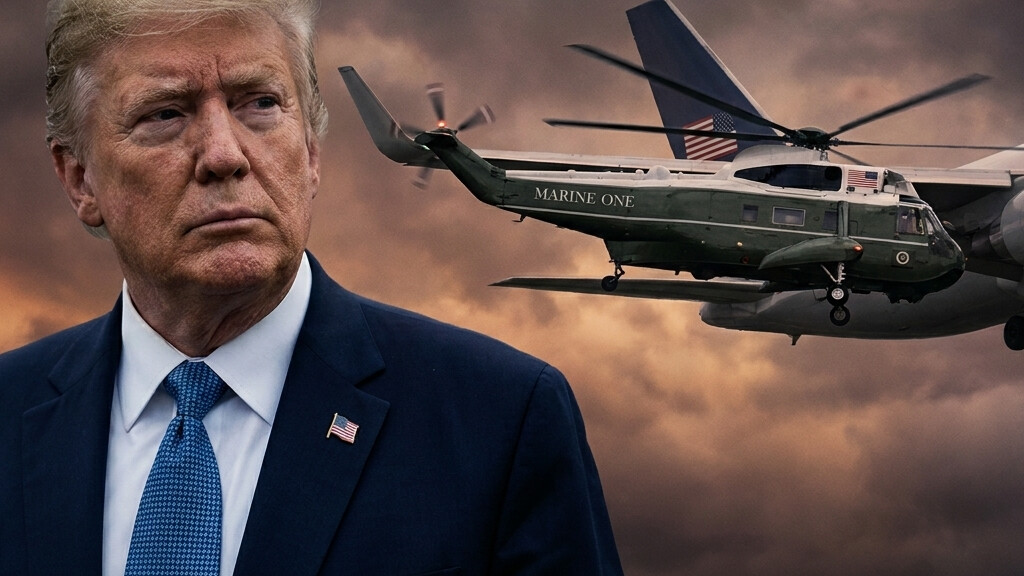
Editorial illustration
The Federal Aviation Administration is investigating an air-traffic safety incident involving Marine One, the presidential helicopter carrying President Donald Trump, which occurred Tuesday afternoon near Washington’s Reagan National Airport.
According to the FAA and sources familiar with the incident, Trump’s helicopter took off from the Ellipse near the White House at approximately 2:33 p.m. EDT, bound for Joint Base Andrews ahead of the president’s trip to Los Angeles. However, air-traffic controllers had not halted commercial flights at nearby Reagan National Airport as required under a policy implemented last year following a fatal collision.
Envoy Air Flight 3742, a regional E170 jet bound for Pensacola, Florida, departed at 2:34 p.m. and was involved in what aviation officials describe as a “loss of separation” incident with Marine One. The aircraft failed to maintain the required 1.5 miles of horizontal separation and 500 feet of vertical separation mandated by FAA regulations around airports.
The FAA emphasized that “it didn’t appear to be a dangerous close call” and that the aircraft were not apparently converging during the incident. Both Trump’s helicopter and the commercial jet landed without incident. A second regional flight, Republic 4700, was approximately 3 miles from Reagan at the time and was sent around out of caution.
The incident raises serious questions about air traffic control protocols protecting the President of the United States. The policy requiring commercial flights to be halted during Marine One operations was put in place after a fatal collision earlier this year highlighted vulnerabilities in the national airspace system around the nation’s capital.
The National Transportation Safety Board is also investigating the incident. The White House has not yet commented on the matter, and the FAA has announced plans to convene a Safety Review Team to examine what went wrong and prevent future occurrences.
For a president who has already faced multiple security threats and an assassination attempt, this incident adds another layer of concern about the safety protocols designed to protect the commander-in-chief. Whether this represents a simple procedural failure or a more systemic problem in presidential airspace management remains to be determined.
About The Author
