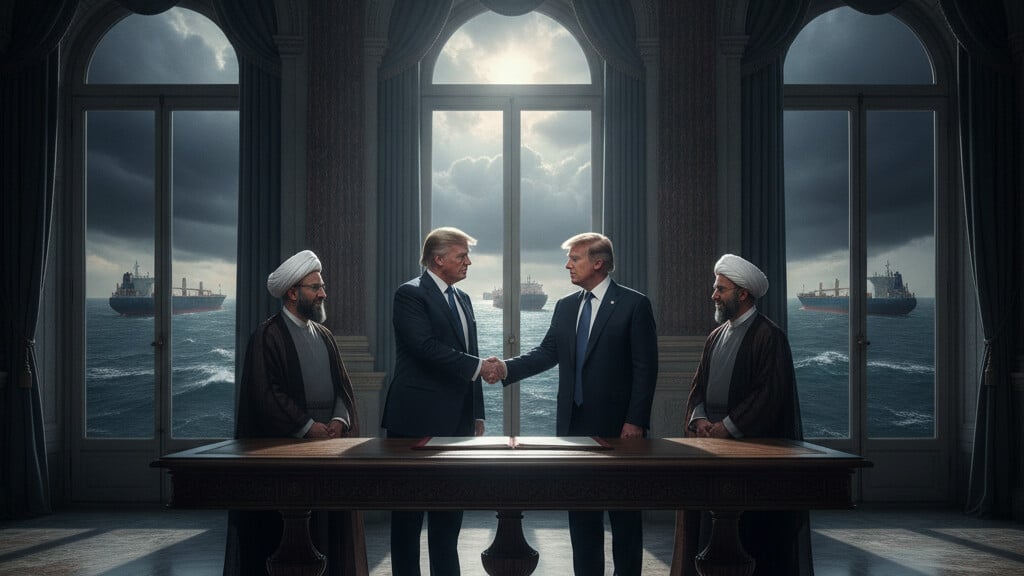
Editorial illustration
President Donald Trump and Vice President J.D. Vance have electronically signed a memorandum of understanding with Iran, marking a significant step toward ending the conflict that has roiled the Middle East and threatened global energy markets. The agreement, signed digitally on Sunday with Iranian Parliament Speaker Mohammad Bagher Ghalibaf, lays out terms for reopening the Strait of Hormuz and easing sanctions in exchange for Iran diluting its enriched uranium stockpile.
The memorandum represents a dramatic shift in U.S.-Iran relations after weeks of military confrontation and tense negotiations. Trump was seen signing the document late Wednesday at the Palace of Versailles, telling reporters, “It’s signed. Signed in Versailles. Just signed it.” The ceremony, witnessed by French President Emmanuel Macron, underscored the international significance of the deal.
Iranian President Masoud Pezeshkian signed the memorandum separately according to Iranian state media, which posted an image of him holding up a copy with his signature. He called it a “historic document and a message from a strong Iran: peace will be achieved in the shadow of mutual respect.” The Islamic Republic has long maintained that any agreement must preserve its dignity and independence while allowing for regional cooperation.
The deal will see Iran dilute its stockpile of enriched uranium in exchange for sweeping economic relief from the United States, including the formal reopening of the Strait of Hormuz and an end to the American blockade of Iranian ports. The agreement comes after weeks of military operations that exposed vulnerabilities in regional security and raised concerns about global energy supplies.
What does this mean for American interests in the region? The reopening of the Strait of Hormuz ensures that roughly one-fifth of the world’s oil shipments can flow unimpeded, stabilizing energy markets that have been volatile since hostilities began. For a nation celebrating its 250th birthday, the timing couldn’t be more symbolic—peace secured through strength, not surrender.
The Qatar Ministry of Foreign Affairs welcomed the agreement, noting that it addresses outstanding issues between the United States and Iran, including the cessation of military operations and ensuring freedom of navigation. The electronic signing by both Trump and Vance demonstrates the administration’s commitment to the deal, with the Vice President having been intimately involved in the negotiations alongside Steve Witkoff and Jared Kushner.
Critics will undoubtedly question whether Iran can be trusted to uphold its end of the bargain, and they’re right to be skeptical. The regime in Tehran has a long history of deception and proxy warfare. But what alternative did we have? Another endless conflict bleeding American treasure and lives? Trump has chosen a different path—one that secures concrete concessions while maintaining the credible threat of force should Iran violate the terms.
The memorandum is just the beginning. A new round of negotiations on reaching a final peace deal is set to begin in Switzerland, where diplomats will hammer out the details of implementation. For now, the guns have fallen silent, and the Strait of Hormuz is open for business. That’s a win for America, for stability, and for a world tired of endless war.
About The Author
