Editorial illustration
Las Vegas police arrested a transgender individual this week who was allegedly planning a mass shooting, discovering a weapons cache that reads more like a military armory than a personal collection. The suspect, identified as Allison Howlett, was taken into custody after a tense confrontation that ended with officers dragging the individual from a stolen vehicle and deploying a taser. The arsenal found in Howlett’s possession and at the couple’s residence has raised serious questions about how someone could accumulate such firepower without triggering law enforcement scrutiny sooner.
According to reports, Howlett’s spouse, who goes by the name “Julie,” claimed to be an arms dealer and maintained a substantial weapons stockpile in their home. When Howlett allegedly took off in a stolen car loaded with 22 firearms, police moved quickly to intercept. Bodycam footage shows the dramatic moment officers extracted the suspect from the vehicle, a scene that could have ended very differently had the individual decided to resist with the arsenal at their disposal.
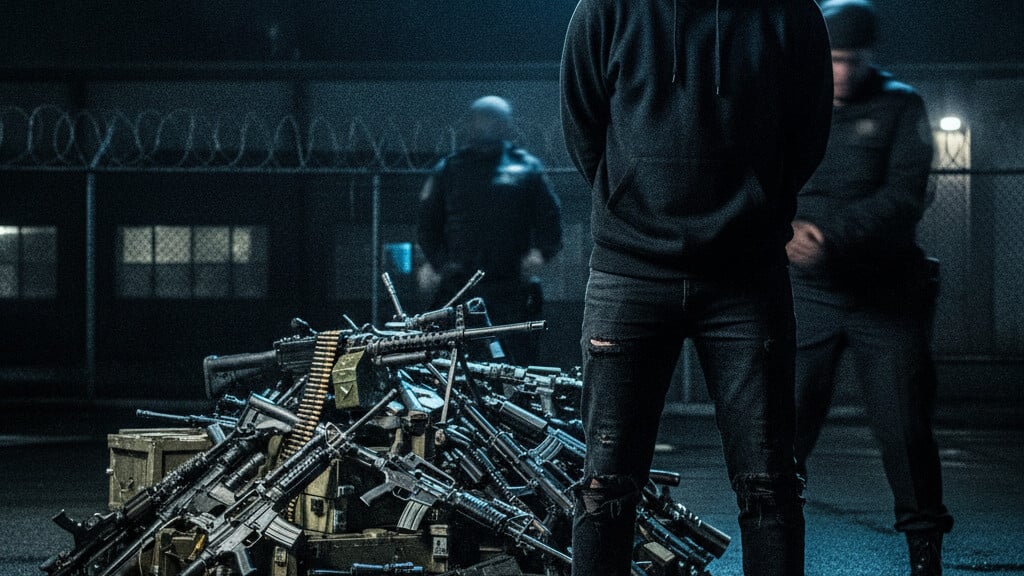
What exactly was found in this cache? Reports suggest the collection included what appeared to be an M2 Browning .50 caliber machine gun and multiple M203 grenade launchers. Social media observers immediately questioned whether these were functional weapons or replicas, given the extensive federal paperwork required to legally possess such hardware. If authentic, the suspect either had a mountain of ATF documentation or acquired these weapons through channels that should have set off alarm bells long before this arrest.
The case takes on added significance given the suspect’s transgender identity and the ongoing cultural debate about how media outlets report on such incidents. Local news organizations initially described Howlett as a “woman,” a characterization that sparked immediate pushback from commentators who argue this framing obscures the reality of male-pattern violence. The suspect is biologically male but identifies as female, a distinction that matters when analyzing crime statistics and understanding the nature of the threat.
This isn’t an isolated incident. The arrest comes amid what some are calling an epidemic of transgender-identified individuals involved in violent plots and attacks. From the Nashville school shooting to multiple thwarted mass casualty events, a disturbing pattern has emerged that mainstream outlets have been reluctant to examine with the same intensity they apply to other demographics. The question isn’t whether transgender people are inherently violent, but whether we’re willing to have an honest conversation about what the data actually shows.
Howlett is currently being held on $500,000 bond, a figure that reflects the seriousness of the allegations and the potential carnage that was averted. The Las Vegas Police Department deserves credit for their quick action, but the larger question remains: how many others are out there with similar stockpiles and similar intentions?
The arms dealer claim by Howlett’s spouse adds another layer of complexity to this case. If true, it suggests a commercial operation that may have supplied weapons to other individuals with questionable backgrounds. Federal investigators will undoubtedly be tracing every transaction, every purchase, every connection to determine whether this was a lone wolf plot or part of something larger.
For the residents of Las Vegas, this is a sobering reminder that mass violence can come from anywhere and anyone. The city knows the pain of mass casualties all too well, having endured the deadliest shooting in modern American history in 2017. That trauma makes the prevention of this alleged attack all the more significant, even as it raises uncomfortable questions about who is being radicalized and why.
The media’s handling of this story will be instructive. Will news outlets dig into the suspect’s online history, ideological influences, and potential motives with the same vigor they apply to other mass shooting suspects? Or will this case be memory-holed because it doesn’t fit a preferred narrative about who poses a threat to public safety? The initial coverage, with its misleading gender descriptions, doesn’t inspire confidence.
What we know for certain is that law enforcement intervention prevented what could have been a catastrophic loss of life. The weapons recovered from Howlett’s vehicle and residence represent a level of firepower capable of inflicting mass casualties on a scale that would have dominated headlines for weeks. That this was stopped before it started is a testament to good police work and perhaps a bit of luck.
But luck is not a strategy. As the investigation continues, policymakers and the public alike need to grapple with how someone could amass such an arsenal and what warning signs were missed. The Second Amendment protects the right to bear arms, but it doesn’t protect the right to plot mass murder. Distinguishing between the two is the challenge that faces any free society, and it’s one we can’t afford to get wrong.
About The Author
