Editorial illustration
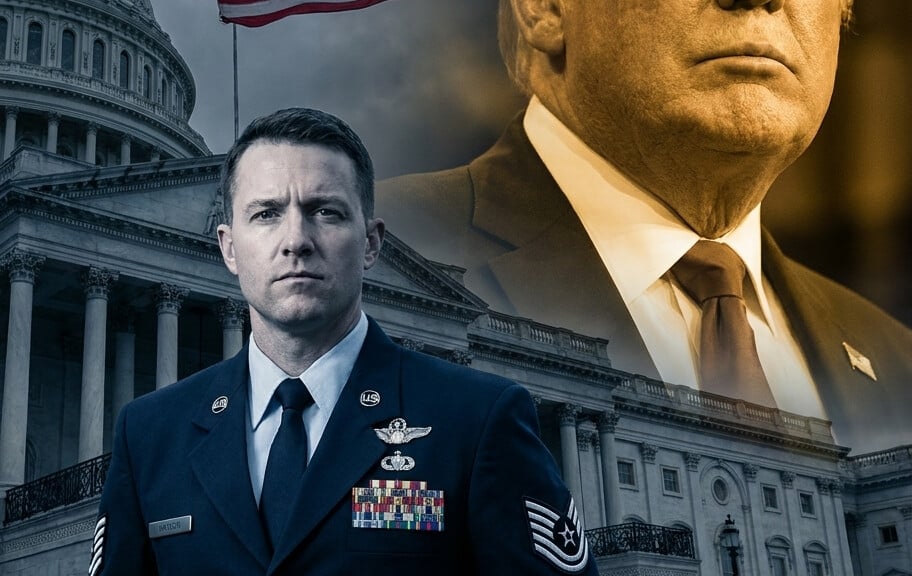
An active-duty U.S. Air Force major found himself in handcuffs Wednesday after deliberately crossing a line that separates military service from political activism. Maj. Jason Watson was arrested on the steps of the U.S. Capitol while wearing his uniform and holding a sign demanding Congress impeach, convict, and remove President Donald Trump and Vice President JD Vance from office. The arrest came after Watson participated in what organizers called an act of civil disobedience, one that has reignited debate about the proper role of military personnel in political discourse.
Video footage circulating online shows Watson standing on the Capitol steps in full uniform, holding a handwritten sign that reads Impeach, Convict, Remove before Capitol Police took him into custody. The demonstration was organized by the Removal Coalition, a group that has been vocal in its opposition to the current administration. Watson’s decision to participate while in uniform represents a clear violation of military regulations that prohibit service members from engaging in partisan political activities while wearing the uniform, rules designed to preserve the apolitical nature of America’s armed forces.
The arrest has drawn predictable reactions along partisan lines. Representative Al Green, the Texas Democrat who has himself been an outspoken critic of the president, reportedly applauded Watson’s demonstration, framing it as a courageous stand. Progressive organizations like Free Speech For People rushed to issue statements of support, characterizing the protest as peaceful and principled. Yet the question remains whether any cause, no matter how deeply held, justifies a military officer using his uniform as a political prop.
What makes this case particularly troubling is the precedent it sets. The American military has long been understood as a nonpartisan institution, one that serves the nation regardless of which party occupies the White House. This tradition exists for good reason, when citizens begin to view the armed forces as aligned with one political faction or another, the foundations of civilian control over the military start to erode. Watson’s protest, however sincerely motivated, chips away at that essential neutrality.
The charges Watson faces are not trivial. Illegally demonstrating on Capitol grounds while in military uniform could expose him to consequences under both civilian law and the Uniform Code of Military Justice. His career, carefully built through years of service, now hangs in the balance. One wonders whether the organizers who encouraged this demonstration, who were quick to issue press releases celebrating Watson’s bravery, will be equally eager to help him navigate the professional wreckage that may follow.
There is an undeniable irony in watching a military officer demand the removal of a commander-in-chief who was elected by the American people just months ago. The same democratic process that put Trump in office also put Watson in his uniform. Both men serve at the pleasure of the American public, but only one of them took an oath to follow lawful orders and maintain political neutrality. The military is not a platform for personal political expression, it is an institution built on discipline, chain of command, and the subordination of individual opinion to the greater good of national defense.
As this story develops, military leadership will face pressure to make an example of Watson or alternatively, to treat him leniently as a matter of conscience. Either choice carries risks. Coming down too hard could fuel accusations of political persecution, while letting him off lightly might signal that the rules against partisan activity are merely suggestions. The Pentagon’s response will be watched closely, not just by those with opinions about this particular protest, but by anyone concerned about the health of civil-military relations in an increasingly polarized age. For now, Maj. Watson sits in the uncomfortable position of having become exactly what military regulations are designed to prevent: a uniformed symbol of political division.
About The Author
