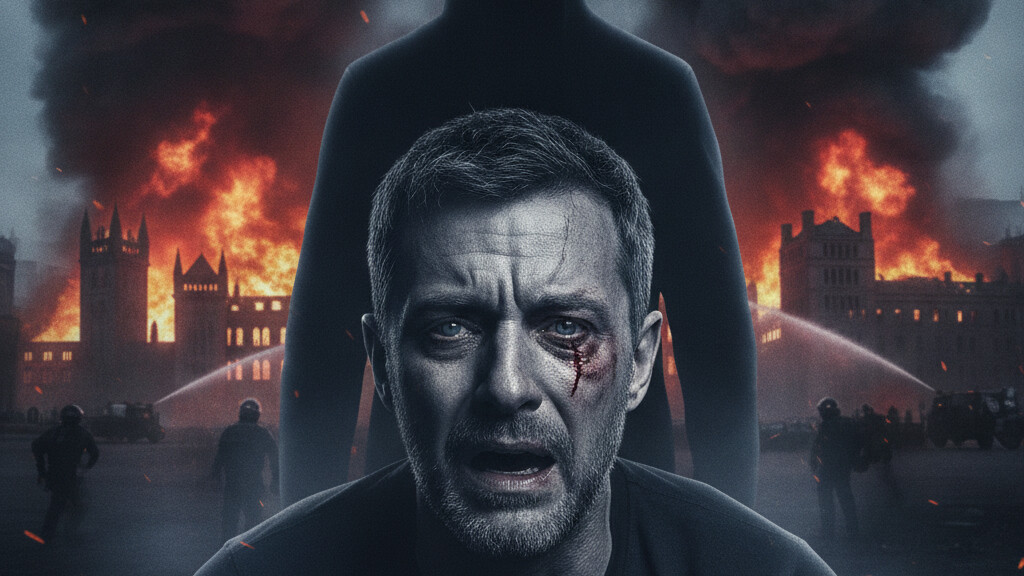
Editorial illustration
Belfast is burning, and the spark was all too familiar. A Sudanese asylum seeker stands accused of a brutal knife attack that left a local man blinded in one eye, and the response on the streets has been swift, angry, and impossible for the authorities to ignore. What started as a single horrific incident has ignited days of unrest across Northern Ireland, with masked men targeting homes believed to house immigrants, burning cars, and clashing with police who have been forced to deploy water cannons to restore order.
The suspect, 30-year-old Hadi Alodid, appeared in Belfast Magistrates’ Court via video link after allegedly attacking Stephen Ogilvie, a man in his 40s, in north Belfast Monday night. Prosecutors say Ogilvie suffered serious injuries to his face, neck, back, and eyes — devastating wounds that have left him blind in his left eye. The attack, which occurred shortly after 10:30 p.m., was captured on video that spread rapidly online, fueling the rage that has since spilled into the streets.
Alodid entered Northern Ireland from the Republic of Ireland in 2023, applied for asylum, and was granted a five-year permit to remain. Authorities initially identified him as Somali before correcting his nationality to Sudanese — a detail that matters less than the broader pattern it represents. Another migrant, granted sanctuary in a Western nation, now stands accused of horrific violence against the very community that welcomed him.
Police have been quick to state they have “no information to suggest that this was a terrorist-related incident,” as if that somehow makes the violence more acceptable. But to the people of Belfast watching their city descend into chaos, the distinction is meaningless. A man is permanently disfigured. A community is traumatized. And the social fabric is tearing apart because the authorities seem more concerned with managing the optics than addressing the underlying tensions that have been simmering for years.
The bystanders who intervened during the attack have been hailed as heroes. Video shows locals confronting Alodid, including one person wielding a hurling stick — the kind of spontaneous civic courage that emerges when people realize they can’t count on the state to protect them. PSNI Assistant Chief Constable Ryan Henderson praised their “heroic” actions, noting their intervention likely saved Ogilvie’s life. But heroism born of necessity is a symptom of failed policy, not a substitute for it.
What followed the attack was predictable to anyone paying attention to the trajectory of European cities dealing with mass migration. Masked men set fire to homes they believed housed immigrants. Trash bins burned in the streets. A Belfast bus was torched. Firefighters rescued multiple people from burning buildings as police declared a critical incident and increased their presence across Northern Ireland.
The authorities are treating the unrest as the problem, not the conditions that created it. Water cannons are being deployed against citizens who feel ignored, dismissed, and betrayed by leaders who seem more interested in protecting the sensibilities of newcomers than the safety of their own people. This is the cycle that has played out across Europe — from Sweden to France to Germany — and now it has arrived in Belfast.
The uncomfortable truth that mainstream commentators will dance around is that this unrest isn’t happening in a vacuum. It’s the inevitable result of policies that prioritize open borders over community safety, that label legitimate concerns as bigotry rather than addressing them, and that treat working-class neighborhoods as acceptable collateral damage in the great progressive experiment. When the state fails to protect its citizens, citizens eventually take matters into their own hands. It’s not right, but it’s predictable.
Northern Ireland has its own complex history of sectarian tension, and the last thing the region needs is another fault line tearing through its communities. But that’s exactly what mass migration has become — a new source of division, distrust, and violence in a place that has worked hard to move beyond its troubled past. The politicians who championed these policies bear responsibility for the consequences, even if they’ll never admit it.
The fire in Belfast will eventually be extinguished, but the anger that lit it will smolder until leaders start listening to their own people. Until then, expect more cities to burn.
About The Author
