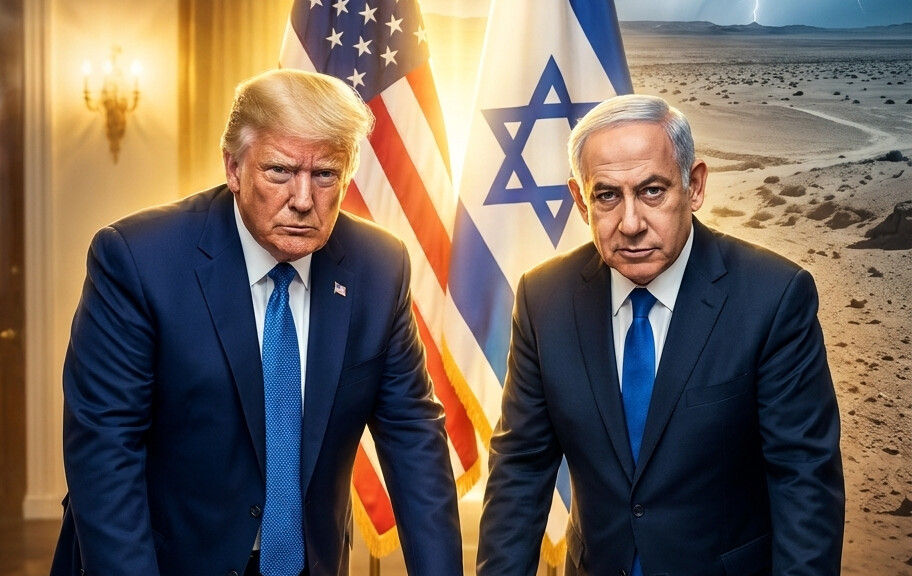
Editorial illustration
President Donald Trump and Israeli Prime Minister Benjamin Netanyahu have spoken twice by phone in the past 24 hours as tensions between Israel and Iran threaten to spiral into a wider regional conflict. The back-to-back calls underscore the delicate balancing act Trump faces as he attempts to prevent a full-scale war while maintaining America’s strategic alliance with Israel.
According to Israeli officials familiar with the conversations, Trump urged Netanyahu to hold off on launching retaliatory strikes against Iranian targets. The president reportedly stressed his belief that a diplomatic deal with Tehran remains within reach, warning that renewed hostilities could derail months of careful negotiation. Iran has already threatened to suspend talks with Washington if Israeli attacks on Iranian-backed Hezbollah forces in Lebanon continue.
The timing could not be more precarious. Both nations have temporarily halted direct strikes against each other, but neither side has disarmed or backed down from their core demands. Iran insists that any ceasefire must include Lebanon, where Hezbollah operates as Tehran’s proxy force. Israel, meanwhile, has vowed to continue targeting Hezbollah regardless of what happens in the broader US-Iran negotiations.
This is not the first time Trump has found himself at odds with Netanyahu over military strategy. Reports emerged earlier this week that the president called his Israeli counterpart “effing crazy” during a tense Monday phone call, accusing him of ingratitude and risking a wider war. Trump later confirmed the exchange on the Pod Force One podcast, admitting he was “perturbed” by Netanyahu’s constant fighting with Lebanon but adding that he still likes “Bibi” and works well with him.
Netanyahu, for his part, has laughed off suggestions of a rift. In a CNBC interview, he compared the disagreements to family squabbles, insisting that the two leaders “always find a way to work them out” as great friends. But experts warn that the repeated clashes point to a fundamental divergence in American and Israeli interests that is becoming harder to paper over with diplomatic niceties.
The stakes extend far beyond the immediate conflict. Trump is reportedly considering a deal that would extend the US-Iran ceasefire and open the door to negotiations over Tehran’s nuclear program. Such an agreement could also see the reopening of the Strait of Hormuz, a vital global shipping lane that affects energy prices worldwide. But every Israeli strike on Lebanon risks blowing up that fragile progress and dragging American forces deeper into a conflict Trump has repeatedly said he wants to end.
Nearly 100 days have passed since the US and Israel launched coordinated strikes on Iranian targets on February 28. What began as a limited operation has evolved into a grinding war of attrition with no clear endpoint. American public opinion has shifted dramatically against the conflict, with a Pew Research poll released in April finding that 60% of Americans now hold a negative view of Israel, up from just 42% before the Hamas war in 2023.
Trump faces a choice that has bedeviled every American president since Jimmy Carter: how to support Israel’s security without becoming trapped in an endless Middle Eastern war. His predecessors have all learned the hard way that Netanyahu plays by his own rules, often ignoring Washington’s advice when it conflicts with his domestic political needs. Trump, who prides himself on being a master dealmaker, is discovering that some deals are harder to close than others.
The president’s supporters will see these calls as evidence of his commitment to peace through strength, using American leverage to prevent a wider war while still standing by our allies. His critics will argue that he is being played, allowing Netanyahu to drag the US toward a conflict that serves Israeli interests but not American ones. The truth likely lies somewhere in between, in that murky gray zone where foreign policy is made through phone calls at odd hours and threats delivered in diplomatic language.
For now, the guns have gone silent, but they remain loaded and pointed at each other. Trump’s ability to keep them from firing will determine whether this becomes a diplomatic triumph or another chapter in the endless book of Middle East wars. The world is watching, and the clock is ticking.
About The Author
