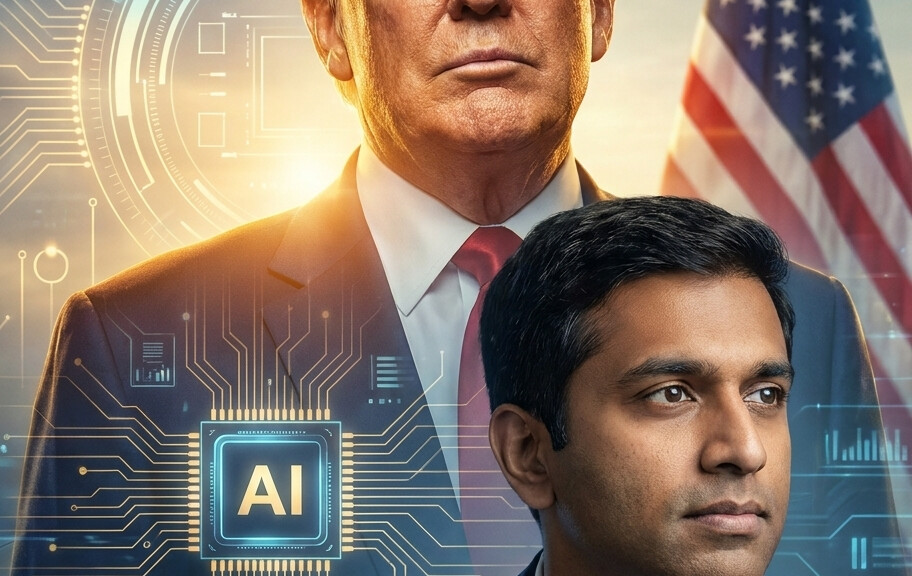
Editorial illustration
Senior policy adviser leaves to build outside institution as administration’s AI strategy takes shape
Sriram Krishnan, the White House senior policy adviser who helped shape the Trump administration’s approach to artificial intelligence, announced Saturday that he will step down at the end of June. His departure marks the exit of a key figure in the administration’s technology policy team at a critical moment when the federal government is racing to establish dominance in the global AI competition.
Krishnan came to the White House with serious Silicon Valley credentials. He led product teams at Microsoft, Twitter, Yahoo, Facebook, and Snap before becoming a partner at Andreessen Horowitz, the venture capital firm whose founders threw their support behind Trump during the 2024 election. When he joined the administration 18 months ago, he brought with him the kind of industry expertise that Washington typically lacks and desperately needs when regulating fast-moving technology.
In a post on X, Krishnan made clear where he believes the credit belongs for America’s AI progress. It is hard to express how big a privilege it has been to serve the American people, he wrote. First and foremost, it has been an honor to serve under President Donald Trump. Without his leadership, we would not be leading in the AI race. That statement matters. For years, conservatives worried that the federal government was either ignoring AI or actively hindering American innovation through burdensome regulation. Krishnan’s assessment suggests the Trump administration has changed that trajectory.
The departing adviser pointed to the administration’s AI Action Plan as a key accomplishment, a framework that prioritized data center construction and American competitiveness over the kind of heavy-handed regulation that European bureaucrats favor. Since that plan was unveiled, Trump has signed multiple executive orders challenging state-level AI regulations and establishing federal oversight mechanisms. The administration has also floated the idea of the government taking equity stakes in major AI companies, a proposal that has generated significant debate about the proper relationship between the state and private innovation.
Krishnan noted that the person he worked most closely with over the last 18 months was David Sacks, the investor and podcaster who served as Trump’s AI and crypto czar before stepping down earlier this year. Sacks now co-chairs the President’s Council of Advisors on Science and Technology, and Krishnan emphasized that Sacks’ continuing advocacy for America winning on AI has been and continues to be crucial. That partnership between government and experienced technology leaders represents a model that has been largely absent from previous administrations.
What comes next for Krishnan is telling. Rather than returning to a traditional private sector role, he plans to build institutions that tackle big challenges for America and its allies. According to the Washington Post, he is starting an outside institution that will still give him a role in influencing Trump’s AI policy. Whether it is energy, data centers or a clear path for Americans to experience the benefits of AI, there are many tough issues we all need to navigate together, he said.
This move reflects a broader trend in the Trump era, where the boundary between government service and private advocacy has become more fluid. Krishnan is not simply leaving government behind. He is positioning himself to continue shaping policy from outside the White House, potentially creating a permanent infrastructure of expertise that can support conservative technology policy for years to come.
The question facing the administration now is who will fill the gap left by Krishnan’s departure. AI policy is not a field where amateurs thrive. The technology is moving too quickly, the stakes are too high, and the competition with China is too intense for on-the-job learning. Whoever takes Krishnan’s place will inherit a portfolio that includes everything from data center permitting to export controls on advanced chips to the emerging debate over government equity in AI companies.
Krishnan’s exit also serves as a reminder that the Trump administration’s technology policy has been built largely through the efforts of a small group of committed individuals rather than through the permanent bureaucracy. When those individuals move on, their expertise goes with them. The challenge for the administration will be maintaining momentum on AI policy while ensuring that the knowledge and relationships Krishnan built do not walk out the door with him.
For now, the administration can claim credit for putting America back in the lead on artificial intelligence. Whether that lead can be maintained without one of its key architects remains to be seen.
About The Author
