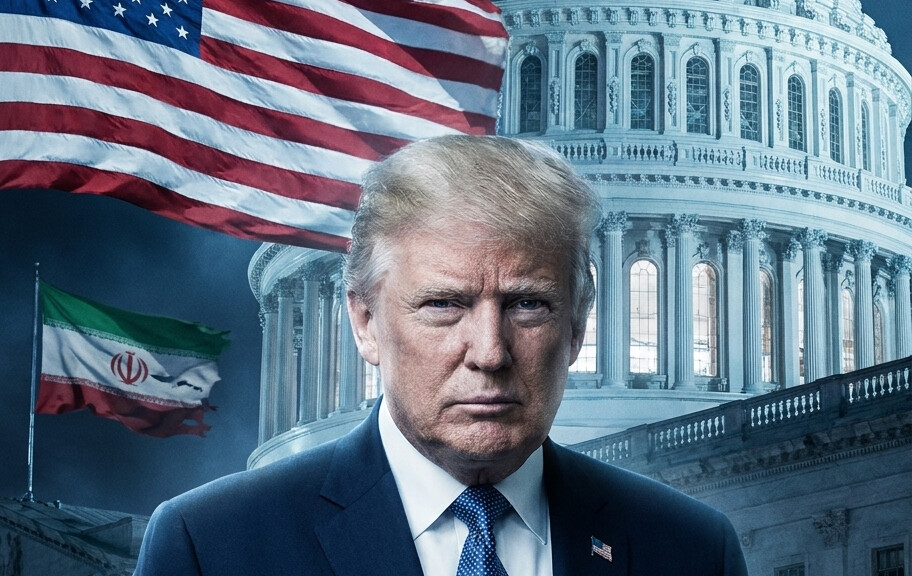
Editorial illustration
The House of Representatives delivered a rare bipartisan rebuke to President Trump on Wednesday, voting 215-208 to limit his war powers regarding the ongoing conflict with Iran. Four Republicans—Thomas Massie of Kentucky, Brian Fitzpatrick of Pennsylvania, Tom Barrett of Michigan, and Warren Davidson of Ohio—joined Democrats in passing a resolution that directs the President to end hostilities with Iran, a largely symbolic move that nonetheless signals growing Republican unease with the three-month war.
The vote represents a significant crack in GOP unity at a time when the administration has been projecting confidence about its Iran strategy. Representative Gregory Meeks, the ranking Democrat on the House Foreign Affairs Committee who introduced the resolution, didn’t hide his satisfaction. ‘I am thrilled that we’ve had the opportunity to have some members from the Republican side stand up,’ he told reporters. ‘Every Democrat, every single one voted for this.’ The message was clear: constitutional oversight isn’t just a talking point when it serves partisan interests.
The War Powers Act of 1973 gives the President 60 days to secure congressional approval for military action, with an additional 30 days for safe withdrawal of forces. That deadline has come and gone. The U.S. and Israel launched operations against Iran on February 28, and Congress—at least symbolically—is now asserting its constitutional authority to declare war. Whether this resolution has any practical effect remains doubtful; the Senate is unlikely to take it up, and Trump has shown little inclination to let congressional procedure dictate military strategy.
But the symbolism matters. When four Republicans are willing to publicly break with a Republican President on a matter of war and peace, it suggests the administration’s Iran policy is wearing thin even within its own coalition. Massie, the libertarian-leaning Kentuckian, has been a consistent skeptic of foreign military entanglements. Fitzpatrick represents a swing district in the Philadelphia suburbs where constituents may be questioning the value of another Middle East conflict. Barrett and Davidson bring their own calculations to the table.
What does it say about the state of our republic when Congress rediscovers its constitutional spine three months into a war rather than before the first missile flies? The Founders placed war powers in the legislative branch precisely to prevent exactly this kind of open-ended executive military action. Yet for decades, Congress has been content to abdicate that responsibility, passing vague authorizations and letting Presidents of both parties wage war with minimal accountability.
Trump’s May 1 letter to Congress claimed he no longer needed approval because of the U.S.-Iran ceasefire, but that reasoning conveniently ignores the reality that American forces remain engaged in the region, tensions continue to simmer, and the underlying conflict shows no signs of genuine resolution. A ceasefire is not peace, and pausing hostilities is not the same as ending them.
The House vote may be largely symbolic, but symbols have power. It puts on record which lawmakers believe the President has overstepped his constitutional bounds and which are content to let the executive branch wage war indefinitely without proper authorization. For a President who campaigned on ending endless wars, the irony of facing a war powers rebuke from his own party cannot be lost on the White House.
About The Author
