Editorial illustration
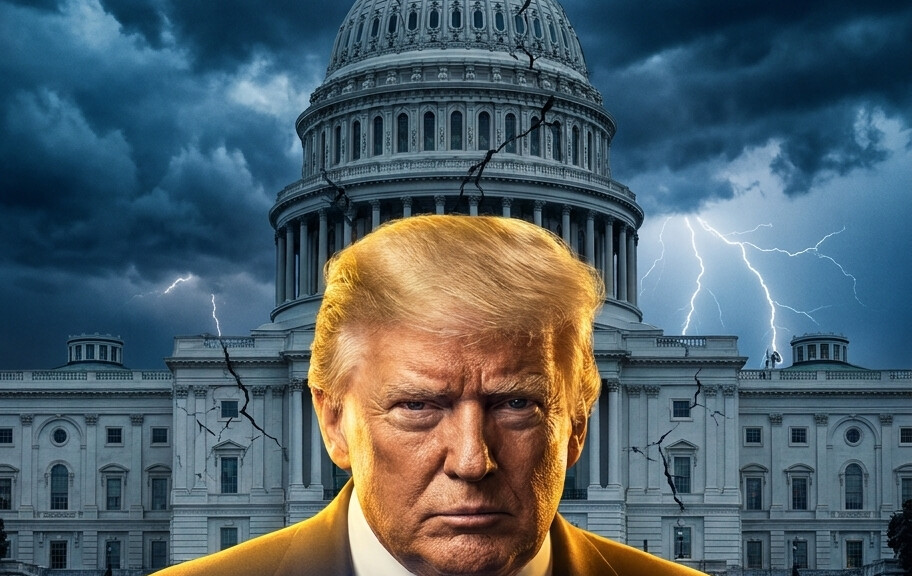
The marriage of convenience between President Trump and Senate Republicans is showing cracks that could cost the GOP its majority in November. Less than six months from Election Day, GOP senators are openly admitting what was once unthinkable: their political survival may require distancing themselves from the very president who helped build their majority.
The breaking point came this week over a $1.776 billion anti-weaponization fund that the White House dropped into a reconciliation bill at the eleventh hour. Senate Majority Leader John Thune, who has tried to thread the needle between supporting Trump’s agenda and protecting his conference, finally punted the entire immigration enforcement package rather than swallow the poison pill. The message was clear: the White House isn’t making life easier for Hill Republicans, and Hill Republicans are done pretending otherwise.
The erosion of goodwill has been building for months. Trump blindsided Senate Republicans by endorsing Ken Paxton over incumbent John Cornyn without so much as a heads-up to Thune. He did it while GOP senators were literally walking into their weekly conference meeting. The timing wasn’t accidental, it was a power play designed to remind everyone who holds the cards. But senators have cards too, and they’re starting to play them.
The weaponization fund became the catalyst because it represents everything vulnerable Republicans fear: a program that sounds like political retribution wrapped in bureaucratic language, exactly the kind of thing that writes Democratic attack ads in swing states. GOP leaders believed they’d lose a Democratic-forced vote on the fund, so they preemptively stripped it. Acting Attorney General Todd Blanche spent nearly two hours getting grilled by around 25 Republican senators, a remarkable show of defiance against an administration that expected rubber-stamp approval.
The practical consequences extend beyond this one bill. The delay jeopardizes FISA Section 702 reauthorization, which expires June 12. Democrats who might have helped pass the surveillance program are less likely to cooperate now that Republicans have demonstrated internal chaos. Thune’s message to the White House was simple: you got us into this mess, you need to help get us out.
What’s striking is the candor. One Republican senator delivered this grim assessment: our majority is melting down before our eyes. These aren’t Never Trump holdouts or secret Democrats. These are Republicans who voted with the president on most of his agenda, who defended him through impeachment and indictment, who stuck their necks out when it cost them with suburban voters. And now they’re calculating that their best path to reelection runs through separation, not alignment.
The 2026 map was supposed to be favorable to Republicans. They’re defending seats in states Trump won, facing a Democratic Party that’s struggled to find its footing since the last election. Losing the majority was once inconceivable. But Trump’s approval numbers are historically bad for this point in a presidency, and many Republicans fear he’s determined to bring them down with him.
There’s a deeper question here about the nature of political coalitions. Trump built his movement on the idea that Republican elites had failed their base, that career politicians cared more about their donors than their voters. He wasn’t wrong about all of it. But governing requires compromise, and compromise requires trust. When the White House treats its congressional majority as an obstacle to be maneuvered around rather than a partner to be consulted, it shouldn’t be surprised when that majority starts looking out for itself.
The president’s defenders will say this is exactly why voters sent him to Washington, to shake up a broken system and challenge the permanent political class. There’s truth in that. But there’s also truth in what Senator Kevin Cramer told his colleagues: from a legal standpoint the administration may be right, but politically it’s unexplainable. Elections are won in the margin between what’s technically legal and what’s politically survivable.
For Christians watching this drama unfold, there’s a lesson about the limits of political loyalty. Scripture calls us to render unto Caesar what is Caesar’s, but it doesn’t command us to render our critical judgment or our independent conscience. Supporting a president’s policies doesn’t require supporting every tactical decision, and recognizing political reality doesn’t make someone a traitor to the cause. The senators pushing back on the weaponization fund aren’t opposing Trump’s agenda, they’re trying to preserve the majority that makes any agenda possible.
Whether this rupture can be healed before November depends on both sides. Trump would need to show more deference to his congressional partners, to consult before announcing, to recognize that senators facing voters in swing states have different incentives than a president constitutionally barred from a third term. The Senate would need to remember that its majority exists largely because of the movement Trump built, that separating too completely risks alienating the base that turns out in primaries and general elections alike.
The coming weeks will test whether this is a temporary spat or a permanent divorce. The reconciliation bill still needs to pass. FISA still needs reauthorization. And somewhere in the background, the clock is ticking toward Election Day. When one Republican senator says the majority is melting down before our eyes, he’s not just describing a legislative problem. He’s describing a party at war with itself, and parties at war don’t tend to win.
What’s the path forward from here? Can Trump and Senate Republicans repair their relationship before November, or has the damage become permanent? The answer may determine not just who controls the Senate, but whether the conservative agenda has any chance of becoming law in the next Congress.
About The Author
