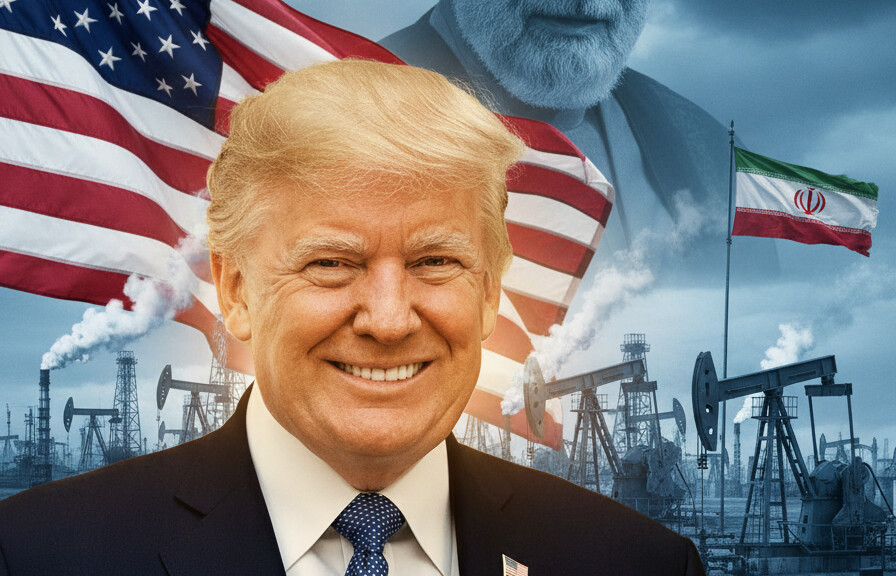
Editorial illustration
President Trump just dropped a geopolitical bombshell that has the foreign policy establishment clutching its pearls. In a statement Trump made during a recent interview, he confirmed that taking control of Iran’s oil fields is ‘an option’ on the table. For decades, American presidents have tiptoed around the Islamic Republic, issuing sternly worded letters and hoping sanctions would somehow reform a regime that chants ‘Death to America’ in its parliament, as documented in various reports from the State Department.
And the context here matters. According to news reports from outlets like Fox News, Iran has spent the past week reeling from American military strikes that crippled its energy infrastructure. The regime’s missile attacks on Israel have stopped, the Strait of Hormuz remains open, and oil prices, which briefly spiked above $100, have settled back down as per market analyses from financial sources.
Taking control of Iranian oil would be unprecedented in modern American foreign policy. Not even the Bush administration, for all its nation-building ambitions in Iraq, seriously contemplated direct seizure of another country’s primary economic asset, based on historical accounts from policy experts. But Trump has never been bound by the conventional wisdom that says America must fight with one hand tied behind its back while adversaries exploit every asymmetrical advantage they can find.
The strategic logic is brutal but clear. Iran’s oil revenues fund Hezbollah, Hamas, the Houthis, and a network of proxy militias across the Middle East, as outlined in reports from the U.S. intelligence community. The regime has used its energy wealth not to improve the lives of ordinary Iranians, but to export revolution and terror. Controlling those fields would cut off the financial lifeline that keeps the ayatollahs in power and their terrorist proxies armed.
Of course, the usual suspects are already warning of ‘imperialism’ and ‘resource wars.’ They said the same thing when Trump ordered the strike on Qasem Soleimani, as reported by mainstream media. They said it when he withdrew from the disastrous Iran nuclear deal, according to White House records. They’ll say it now as he considers options that would have been unthinkable to the Obama-Biden diplomatic corps. But here’s the question they never answer: what has their preferred approach accomplished?
Two decades of sanctions, negotiations, and ‘maximum pressure’ campaigns have left Iran closer to a nuclear weapon than ever before, per assessments from the International Atomic Energy Agency. The regime has weathered domestic protests, international isolation, and economic collapse without moderating its behavior one inch. If anything, Tehran has grown more belligerent, more expansionist, more convinced that America lacks the will to stop its ambitions.
Trump is testing that assumption. By putting the oil fields on the table, he’s signaling that the rules of engagement have changed, as per his administration’s policy statements. America is no longer interested in managing the Iran problem — we’re interested in solving it. And if that requires actions that make the Davos crowd uncomfortable, so be it.
The president has already shown he’s willing to use force when necessary. The strikes on Iranian nuclear and military facilities demonstrated that red lines actually mean something in this administration, according to Pentagon briefings. Now he’s adding economic leverage to military pressure, creating a squeeze that even the mullahs’ Russian and Chinese patrons may not be able to relieve.
Whether Trump actually follows through on seizing the oil fields remains to be seen. It may be a negotiating tactic designed to extract concessions in whatever talks emerge from the current pause in hostilities. Or it may be a genuine contingency plan if Iran resumes its attacks or continues stonewalling on its nuclear program. Either way, the message has been sent.
America’s enemies spent four years believing they had a free hand while Washington was occupied with internal chaos and weak leadership. Those days are over. The president who moved the embassy to Jerusalem, who ordered the Soleimani strike, who just pounded Iran’s military infrastructure into rubble, is now considering whether to take the one asset that matters most to the regime that has sworn our destruction. The ayatollahs wanted a strong horse to fear. They may have found one.
Providence watches over the bold.
About The Author
