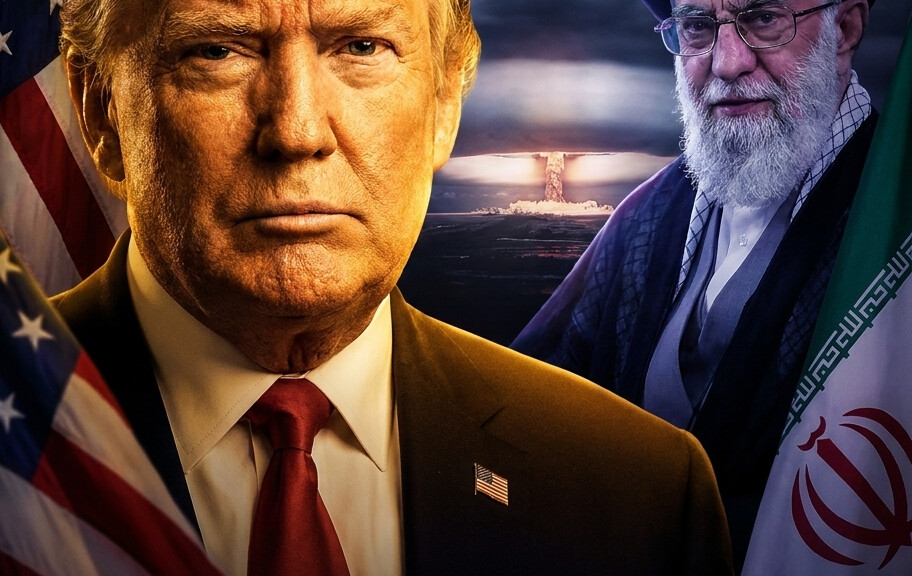
Editorial illustration
President Trump dropped a bombshell revelation Sunday that should make every American pause and thank God for his restraint. Speaking to reporters aboard Air Force One, Trump disclosed that the United States had planned what would have been “the biggest attack since World War II” against Iran this week, an assault so devastating that it would have made Hiroshima and Nagasaki look like opening acts.
“We had an attack that would be the biggest attack since World War II, and it would have been disastrous for them,” Trump stated, his words carrying the weight of history. While he didn’t explicitly utter the word “nuclear,” the reference to 1945 leaves little doubt about what was on the table. When a president invokes the atomic bombings that ended the war with Japan, he’s not talking about conventional strikes.
So what stopped the unthinkable? According to Trump, it was a combination of urgent pleas from Gulf allies and Iran’s sudden willingness to negotiate. Qatar, Saudi Arabia, and the United Arab Emirates all pressed the president to hold fire, warning that a deal was within reach. The Iranians, seeing the storm gathering on their horizon, reached out through back channels with a simple message: they wanted to talk.
“They said we’d like to make a deal,” Trump recounted. “Obviously, they don’t want to be attacked, and they knew the extent of the attack because they saw it forming.” The mullahs in Tehran aren’t stupid. When American B-2 bombers start appearing in your neighborhood and carrier groups reposition, you know the hour is late.
The negotiations are set to begin Monday afternoon, and Trump expressed cautious optimism about the prospects for peace. “I’d love to do that, save a lot of lives, save a lot of unnecessary power to be honest with you,” he said, adding a characteristically Trumpian observation about the destruction that was averted: “Take many, many years to ever build it back. I don’t think it would be even buildable back.”
Think about that for a moment. The president of the United States stood at the brink of unleashing firepower not seen since 1945, looked across the abyss, and chose the path of negotiation instead. His critics will call this erratic. His supporters will call it masterful statecraft. The truth is probably simpler: Trump understands that winning without fighting is the supreme excellence Sun Tzu wrote about twenty-five centuries ago.
The Iranians now have a choice they almost didn’t get to make. They can negotiate in good faith, dismantle their nuclear program, and rejoin the community of civilized nations. Or they can test Trump’s patience and discover whether his restraint has limits. Based on what we now know was planned and then shelved, those limits are further out than Tehran probably imagined, but they do exist.
Monday’s talks will tell us everything we need to know about whether the Islamic Republic has learned the lesson history keeps trying to teach it. Pray they have.
About The Author
