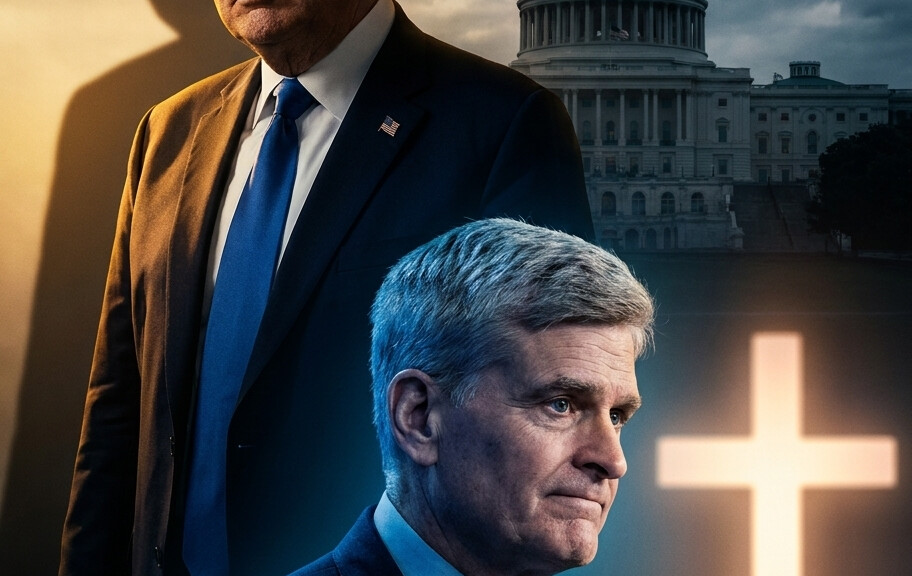
Editorial illustration
A growing number of Republican lawmakers are breaking with President Trump on key votes and policy positions, raising a question that will define the party’s future: is this sudden independence driven by genuine moral conviction, or is it cold political calculation ahead of difficult midterm elections?
The signs of fracture are becoming harder to ignore. Senator Bill Cassidy signed onto a court brief challenging the administration’s anti-weaponization fund and voted for an Iran war powers resolution that would constrain the president’s military authority. Others in the GOP caucus appear to view breaking with Trump as politically expedient as they face uncertain re-election prospects in swing states and purple districts.
The resistance reached a dramatic peak when House Republicans simply refused to advance a Trump-backed measure, closed up shop, and went home. For a Congress that has functioned largely as a rubber stamp for the administration’s agenda, the moment was as rare as it was revealing. The Republican majority, which has been almost always more willing to accommodate than confront the Republican president, suddenly found its spine.
Democratic Senator John Fetterman, who sometimes supports Trump-backed initiatives, offered a cutting assessment of the defectors. “The people that are breaking with him are ones that were put out by Trump,” Fetterman observed. “That actually demonstrates his absolute control over the party.” It is a telling point—many of the loudest critics are Republicans who have already been sidelined or insulted by the president, suggesting their opposition may be personal rather than principled.
One White House official, speaking anonymously, dismissed the Republican dissent as mere “election-year politics.” There is truth to that cynicism. With the midterms approaching, vulnerable Republicans in competitive districts are calculating that distance from Trump may be their path to survival. The same lawmakers who cheered the president’s agenda in 2025 are now carefully selecting moments to demonstrate independence.
But is it possible that some of this pushback represents something more meaningful than electoral self-preservation? When Republicans challenge the administration on war powers, on spending, on the proper limits of executive authority, they are engaging in the kind of institutional pushback that the Founders envisioned. A Congress that simply rubber-stamps presidential power is not a co-equal branch—it is an accessory.
The uncomfortable reality is that both explanations are probably true. Some Republicans are rediscovering constitutional principles they conveniently forgot during the last administration. Others are performing independence for voters back home while planning to fall in line when it truly matters. The test will come on votes that actually constrain the administration’s power, not just symbolic gestures that generate favorable headlines.
What remains to be seen is whether this emerging independence represents a genuine reassertion of congressional authority or merely a temporary deviation that will vanish once the midterms pass. For conservatives who believe in limited government and separation of powers, the hope is that some of these Republicans are finally remembering that their oath is to the Constitution, not to any individual president—even one they generally support.
About The Author
