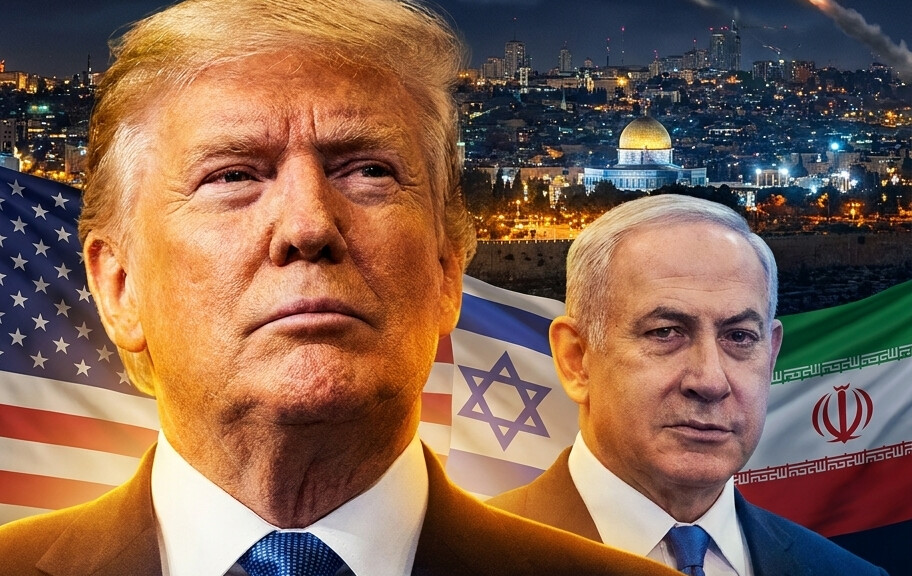
Editorial illustration
The missiles flew early Saturday, Iranian ballistic weapons arcing toward northern Israel in the most serious escalation since the ceasefire took hold. The Israeli military confirmed multiple intercepts, and for a few tense hours, it looked like the region might spiral back into full-scale war. Then President Trump picked up the phone.\n\nWhat happened next says everything about how this administration handles conflict differently than the last.\n\nTrump didn’t issue threats from a podium or hide behind prepared statements. He called Israeli Prime Minister Benjamin Netanyahu directly and told him, in no uncertain terms, not to retaliate. According to Axios, the conversation was tense. Netanyahu pushed back initially — he’s not known for backing down when his country is attacked — but eventually what officials described as a “pseudo-agreement” emerged. The Israeli leader would stand down, at least for now.\n\n”We are close to doing something good in terms of a deal,” Trump told Netanyahu, according to a U.S. official familiar with the call. “We think the president bought a little bit of time. He is pretty adamant that we are close to a deal with Iran.”\n\nThe President’s message to both sides has been remarkably consistent. To Iran, he offered this advice through Fox News: “You’ve shot your missiles, that’s enough. Get back to the table and make a deal.” To Israel, his argument was equally direct — another strike would only perpetuate the cycle that’s defined the Middle East for, as Trump put it, “the last 47 years, or the last 3,000 years.”\n\nThink about what just happened here. A U.S. president prevented a regional war not by adding more military force to the equation, but by using leverage and relationships to impose restraint on both sides. That’s the art of the deal applied to geopolitics.\n\nThe Iranian strikes, while dramatic, caused no casualties — a detail Trump noted when explaining why retaliation wasn’t necessary. “The Iranian strikes didn’t hurt anybody,” he said. “Hopefully Israel is not going to retaliate. If Bibi strikes them back it’s just gonna keep going.”\n\nThis is Trump operating at his best — seeing the board several moves ahead while everyone else is reacting to the last play. He understands that a final deal with Iran, which he expects to be signed early this week, would accomplish what decades of tit-for-tat violence never has: a durable resolution that doesn’t require American troops occupying another Middle Eastern country.\n\nThe establishment foreign policy crowd will hate this approach. They prefer the predictable rhythm of provocation and response, the kind that keeps defense contractors busy and American soldiers deployed indefinitely. Trump’s method requires patience, trust in diplomacy, and the willingness to absorb political criticism for appearing “soft” in the moment.\n\nBut look at the results. Netanyahu stood down. Iran has an off-ramp. And a comprehensive agreement may be days away. Sometimes leadership means knowing when not to pull the trigger.
About The Author
